
Living Soil in Containers: What It Is, Why It Matters, and How to Actually Build It
Most people think soil is just something that holds plants upright.
But healthy soil is not “dead dirt.”
It’s an ecosystem.
A single tablespoon of healthy living soil can contain:
billions of microorganisms
fungi networks
beneficial bacteria
decomposing organic matter
microscopic nutrient cycles
This biological activity is what many gardeners refer to as:
→ “living soil”
And yes—it can exist in containers.
But container living soil behaves very differently than living soil in the ground.
What Is “Living Soil”?
Living soil is soil containing:
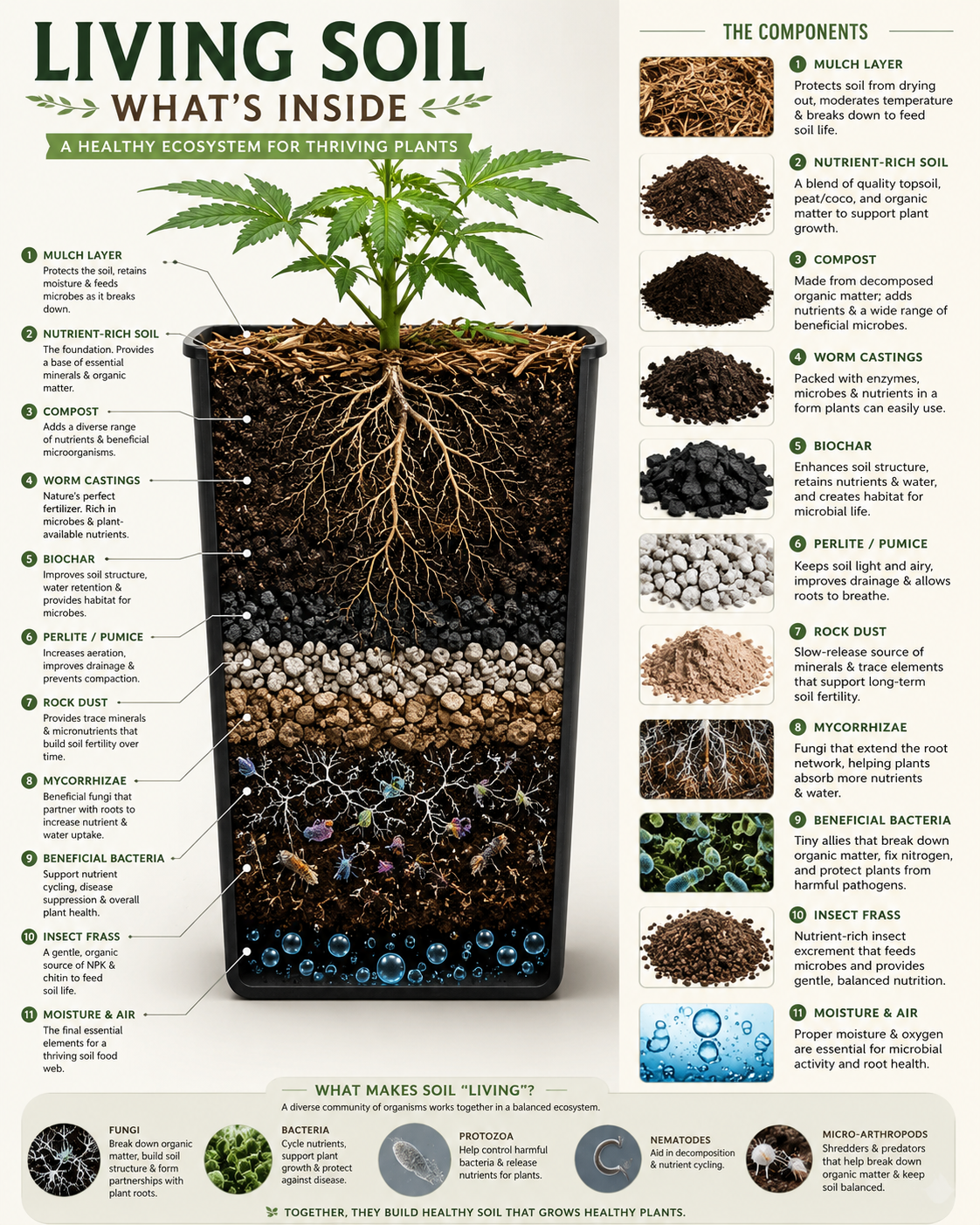
active microbial life
decomposing organic matter
fungi and bacteria that cycle nutrients naturally
Instead of feeding the plant directly with synthetic fertilizer:
→ you feed the soil ecosystem
The soil biology then helps convert nutrients into plant-available forms.
Research confirms that soil microbes significantly influence:
nutrient cycling
water retention
root development
plant resilience
Source:
https://www.fao.org/3/i2800e/i2800e.pdf
Can Living Soil Actually Work in Containers?
Yes—but with limitations
In-ground ecosystems are naturally stable because they have:
enormous biological diversity
deep moisture reserves
worms and soil organisms
temperature buffering
Containers are much smaller and more fragile ecosystems.
This means:
biology fluctuates faster
moisture swings affect microbes more severely
overheating can damage soil life
So container living soil requires:
→ more stability than ground soil
Do Live Worms Count as Living Soil?
Absolutely
Earthworms are one of the strongest indicators of biologically active soil.
In fact, worms are often called:
→ “ecosystem engineers”
because they actively improve:
aeration
nutrient cycling
soil structure
microbial diversity
organic matter decomposition
Research shows worm activity can significantly improve:
water infiltration
oxygen movement
root penetration
nutrient availability
Source:
https://www.nature.com/scitable/knowledge/library/earthworms-and-soil-fertility-88062413/
What Worms Actually Do Inside Container Soil
1) Create Natural Aeration
As worms move through the soil:
they create channels and tunnels
improve airflow
reduce compaction
This helps roots access:
oxygen
moisture
nutrients more efficiently
2) Produce Worm Castings
Worms consume:
decaying roots
compost
organic matter
microbes
Then convert it into:
→ worm castings
Worm castings contain:
plant-available nutrients
beneficial microbes
biologically active compounds
This makes nutrients more available to plants naturally.
3) Increase Biological Activity
Worm digestive systems help distribute and multiply microbes throughout the soil.
This strengthens:
microbial diversity
decomposition activity
nutrient cycling efficiency
Healthy worm populations are often a sign the soil ecosystem itself is healthy.
Best Worms for Container Living Soil
The most common and effective:
Red wigglers (Eisenia fetida)
Why they work well:
tolerate shallow soil systems
thrive in organic-rich environments
adapt well to containers
Typical populations:
Small indoor pot (1–3 gal)
5–15 worms
5-gallon container
25–50 worms
Large raised containers
50–200+ worms
Worm populations usually self-regulate based on:
food supply
moisture
oxygen availability
Why Most Container Soil Is NOT Truly “Living”
Many commercial potting mixes are:
sterile or semi-sterile
peat-heavy
low in biological diversity
Even organic mixes often contain:
limited microbial populations
little long-term biological activity
After repeated drying:
microbial populations decline significantly
Research shows that soil microbial activity drops sharply during repeated drought cycles.
Source:
https://www.sciencedirect.com/science/article/pii/S0038071716302249
What Living Soil Actually Does for Plants
Healthy living soil can improve:
nutrient availability
root development
moisture retention
disease resistance
Some soil fungi form relationships with roots called:
→ mycorrhizae
These networks help plants:
absorb phosphorus
access water more efficiently
expand effective root area
Source:
https://www.fs.usda.gov/wildflowers/mycorrhizae/what_are_mycorrhizae.shtml
The Biggest Challenge in Container Living Soil
Moisture Stability
Microbial life needs:
oxygen
moisture
moderate temperatures
Containers often experience:
dry/wet cycles
overheating
compaction
These conditions damage soil biology.
Repeated drought stress can:
reduce microbial populations
slow nutrient cycling
weaken fungal networks
Worms are especially vulnerable to:
dry soil
overheating
oxygen-poor saturated conditions
This is one reason many container gardens become biologically inactive over time.
How to Build Living Soil in a Container
A strong container living soil usually contains:
Base Structure (~50–60%)
peat moss or coco coir
compost
aeration materials
Aeration (~20–30%)
perlite
pumice
rice hulls
bark fines
Biological Inputs (~10–20%)
worm castings
compost
biochar (optional)
mycorrhizal inoculants
Optional:
live red wigglers for long-term biological activity
Example Living Soil Mix (5-Gallon Container)
A balanced beginner mix:
40% coco coir or peat
25% compost
20% perlite/pumice
10% worm castings
5% bark or biochar
Optional:
25–50 live red wigglers
This creates:
airflow
moisture retention
biological activity
natural decomposition cycling
How to Keep Living Soil Alive
Living soil is not “set and forget.”
The biology must be protected.
Avoid:
letting soil fully dry out
overwatering constantly
excessive synthetic fertilizer salts
overheating containers
Support biology with:
compost top-dressing
organic matter additions
stable moisture levels
Why Stable Moisture Is So Important
Microbial life collapses under repeated drying.
Research shows:
microbial respiration declines sharply in drought conditions
beneficial fungi networks become disrupted
nutrient cycling slows significantly
Source:
https://www.sciencedirect.com/science/article/pii/S0038071716302249
This means:
→ inconsistent watering damages not just plants—but the soil ecosystem itself.
How the Bucket Oasis Supports Living Soil
The Bucket Oasis is naturally aligned with one of the biggest needs of living soil:
→ moisture stability
Because the system:
continuously supplies water from below
reduces severe dry/wet cycles
maintains more stable moisture zones
it can help:
support microbial consistency
reduce drought stress on soil biology
help worms survive more consistently
keep organic matter active longer
The air gap also helps preserve:
oxygen availability
root respiration
aerobic biological activity
This is especially important in containers, where biological systems are less stable than ground soil.
What Living Soil Does NOT Mean
Living soil does NOT mean:
never fertilizing
never refreshing soil
unlimited plant growth
Container ecosystems still have limits:
root volume
nutrient demand
oxygen availability
The goal is:
→ creating a more biologically active and stable root environment
The Takeaway
Living soil is not just soil with compost added.
It’s a functioning biological ecosystem.
Research shows that healthy soil biology improves:
nutrient cycling
root function
plant resilience
water efficiency
Worms can play a major role by:
improving aeration
recycling organic matter
supporting microbial activity
But container living soil requires something critical:
→ stability
Without stable moisture and oxygen, soil biology declines quickly.
That’s why successful container living soil systems depend not only on what’s in the soil—but on maintaining conditions that allow the ecosystem to stay alive.
