
How to Fix Common Problems in Reused Container Soil
Reused soil usually fails for four main reasons:
compaction
loss of aeration
nutrient depletion
poor moisture behavior
The good news:
most of these problems are fixable.
The key is understanding that fertilizer only restores nutrients—it does NOT restore soil structure.
Problem #1: Compaction
What It Looks Like
Compacted soil:
feels dense or heavy
drains slowly
stays soggy longer
develops hard sections
causes roots to circle tightly
In severe cases:
water pools on top for 10–30 seconds before soaking in
Why it happens:
roots compress the soil over time
organic materials decompose into smaller particles
repeated watering collapses air gaps
Research shows compacted soils reduce:
oxygen diffusion
root expansion
nutrient uptake
Source:
https://www.fao.org/3/i2800e/i2800e.pdf
How to Fix Compaction
Best Fixes:
Add:
10–30% perlite
orchid bark
coarse coco chips
pumice
These materials:
create permanent air gaps
reduce soil density
improve oxygen flow
For severe compaction:
replace:
→ 30–50% of the old soil entirely
Problem #2: Loss of Aeration
What It Looks Like
Poor aeration causes:
slow growth
yellow leaves
drooping despite moist soil
root rot risk
The issue:
roots need oxygen as much as water.
Healthy container soil typically contains:
~25% air space after watering
Old compacted mixes may drop far below that.
Source:
https://www.sciencedirect.com/science/article/pii/S0304423805003262
How to Restore Aeration
Add coarse materials:
Best options:
perlite
rice hulls
bark fines
pumice
Target:
→ 15–30% coarse aeration material in the mix
Avoid:
fine sand
clay-heavy soil
pure compost additions
These often worsen compaction.
Problem #3: Hydrophobic Soil (Water Repelling)
What It Looks Like
Old peat-based soil often:
shrinks away from pot edges
sheds water from the surface
develops dry pockets
You water it…
but the center remains dry.
Why?
As peat dries repeatedly:
→ it becomes hydrophobic (water repellent)
How to Fix Hydrophobic Soil
Best Fixes:
slowly rehydrate from below
soak the container thoroughly once
mix in fresh compost or coco coir
Adding:
→ 20–40% fresh organic material
helps restore moisture behavior.
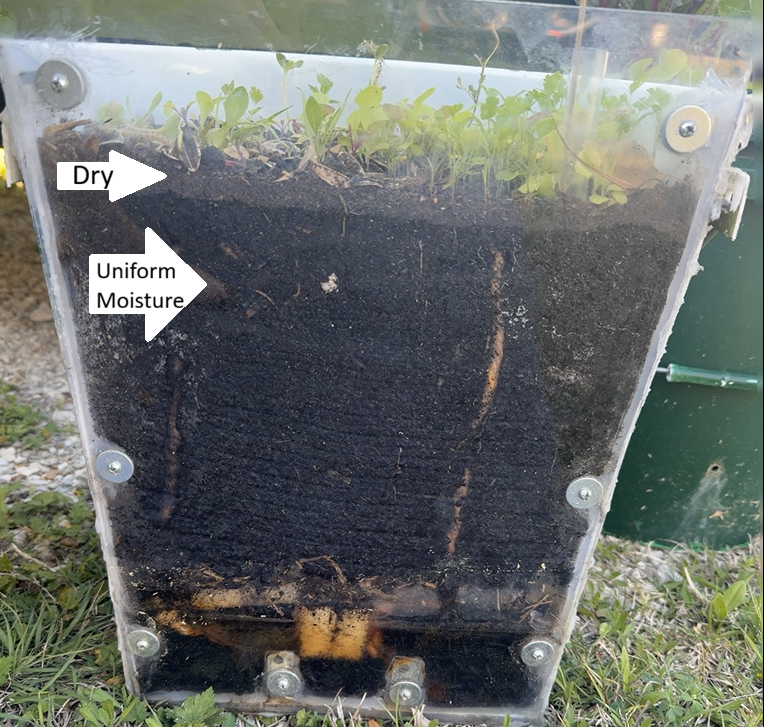
This is one area where bottom-fed systems can help significantly because moisture gradually rehydrates dry zones instead of flooding from above.
Problem #4: Nutrient Depletion
What It Looks Like
Common symptoms:
pale leaves
weak growth
smaller plants
low yield
Heavy-feeding plants like tomatoes can significantly deplete:
nitrogen
potassium
calcium
in a single season.
Source:
https://edis.ifas.ufl.edu/publication/CV216
How to Restore Nutrients
Add:
fresh compost
slow-release fertilizer
organic granular fertilizer
Typical refresh:
1–2 tablespoons slow-release fertilizer per gallon of soil volume
OR:
20–30% compost blended into the mix
Problem #5: Salt Buildup
What It Looks Like
Signs:
white crust on soil surface
leaf tip burn
declining growth despite fertilizing
This is common in:
heavily fertilized containers
self-watering systems
indoor plants
Salts accumulate because:
water evaporates
minerals remain behind
How to Fix Salt Buildup
Best Fix:
Flush occasionally with clean water.
Typically:
water heavily until ~20% drains through
This dissolves and removes excess salts.
For severe buildup:
partially replace soil
Problem #6: Root-Bound Soil Structure
What It Looks Like
After a full season:
roots may form dense mats
soil becomes physically occupied by roots
This reduces:
airflow
water distribution
root expansion space for next season
How to Fix Root-Bound Soil
Best Fix:
remove old root masses
break apart dense root zones
screen out thick roots if needed
Then:
remix the soil thoroughly
add fresh structure materials
The Ideal Reused Soil Refresh Recipe
Lightly Used Soil:
70–80% old soil
20–30% fresh compost/potting mix
10–15% perlite or bark
Heavily Used Soil:
50–70% old soil
30–50% fresh material
15–25% aeration amendment
How the Bucket Oasis Helps Reused Soil
Old soil often struggles most with:
→ inconsistent moisture behavior
The Bucket Oasis helps by:
gradually rehydrating dry zones
reducing severe wet/dry cycles
maintaining more stable moisture levels
This improves:
root stability
microbial activity
water distribution consistency
However:
it does NOT replace the need to restore:
structure
aeration
nutrients
Those still must be corrected physically.
The Takeaway
Reusing soil successfully is not about “saving old dirt.”
It’s about rebuilding the conditions roots need:
oxygen
structure
stable moisture
nutrients
Most reused soil problems are fixable.
But each issue requires a different solution:
fertilizer fixes nutrients
perlite fixes aeration
compost restores biology and structure
flushing fixes salts
When those are addressed properly, container soil can remain productive for multiple growing seasons.
