
Soil Oxygen: The Missing Piece in Container Gardening (And How System Design Changes Everything)
Most plant problems are blamed on watering.
Too much.
Too little.
Wrong timing.
But what’s often missed is what watering actually affects:
oxygen at the roots
In container gardening, water and oxygen are directly linked. And when that balance is off, plants don’t just struggle—they slowly decline.
Roots Need Air as Much as Water
Plant roots don’t just absorb water—they respire.
They require oxygen to:
convert sugars into usable energy
absorb nutrients
support new growth
When oxygen is limited, these processes slow or stop.
Research shows that root respiration declines rapidly in low-oxygen conditions, reducing nutrient uptake and plant growth.
Source:
https://www.fao.org/3/i2800e/i2800e.pdf
What Happens When Soil Loses Oxygen
Soil contains both:
water-filled pores
air-filled pores
Healthy soil maintains a balance between the two.
But when soil becomes saturated:
air pockets are displaced
oxygen diffusion drops significantly
roots begin to suffocate
This condition—often called waterlogging—is one of the most common causes of plant decline.
Research confirms that excess water reduces oxygen availability in soil, leading to root stress and reduced performance.
Source:
https://www.sciencedirect.com/science/article/pii/S0304423805003262
Why Overwatering Is Really an Oxygen Problem
Overwatering isn’t harmful because of the water itself.
It’s harmful because it replaces oxygen.
This leads to:
reduced root respiration
poor nutrient uptake
increased susceptibility to root rot
Extension guidance consistently identifies excess moisture and poor aeration as primary causes of root failure in containers.
Source:
https://extension.umn.edu/planting-and-growing-guides/watering-container-plants
Why Containers Make This Worse
Containers are less forgiving than ground soil.
They have:
limited volume
restricted drainage
faster moisture swings
This creates rapid transitions:
saturated → dry → saturated
Each cycle disrupts oxygen levels and stresses roots.
Research shows that fluctuating soil moisture is more harmful than stable conditions—even if both reach similar extremes.
Source:
https://www.sciencedirect.com/science/article/pii/S0304423805003262
The Goal: Balance Water and Oxygen at the Same Time
Healthy root systems require both:
water for hydration
oxygen for function
Too dry:
roots can’t absorb water
Too wet:
roots can’t breathe
Optimal growth happens when:
→ water and oxygen coexist in the soil
This balance is controlled by:
soil structure
container design
how water is delivered
Source:
https://www.fao.org/3/r4082e/r4082e.pdf
Why Traditional Watering Struggles to Maintain This Balance
Top watering introduces water in bursts.
This leads to:
rapid saturation
temporary oxygen loss
uneven distribution
Then:
water drains or evaporates
soil dries
oxygen returns
This repeated cycle creates instability.
Even experienced gardeners are constantly adjusting to maintain balance.
Why “Better Drainage” Isn’t a Complete Fix
A common solution is:
“add more drainage holes” or “use faster-draining soil”
While helpful, this doesn’t solve the core issue.
Problems still occur when:
water is applied unevenly
soil cycles between extremes
moisture distribution is inconsistent
Drainage improves exit—but not delivery.
How System Design Changes Root Oxygen Availability
The biggest shift comes from changing how water enters and moves through the container.
Instead of flooding soil from above, a controlled system:
supplies water gradually
maintains stable moisture levels
preserves air-filled pore space
This reduces the cycle of:
→ saturation → oxygen loss → recovery
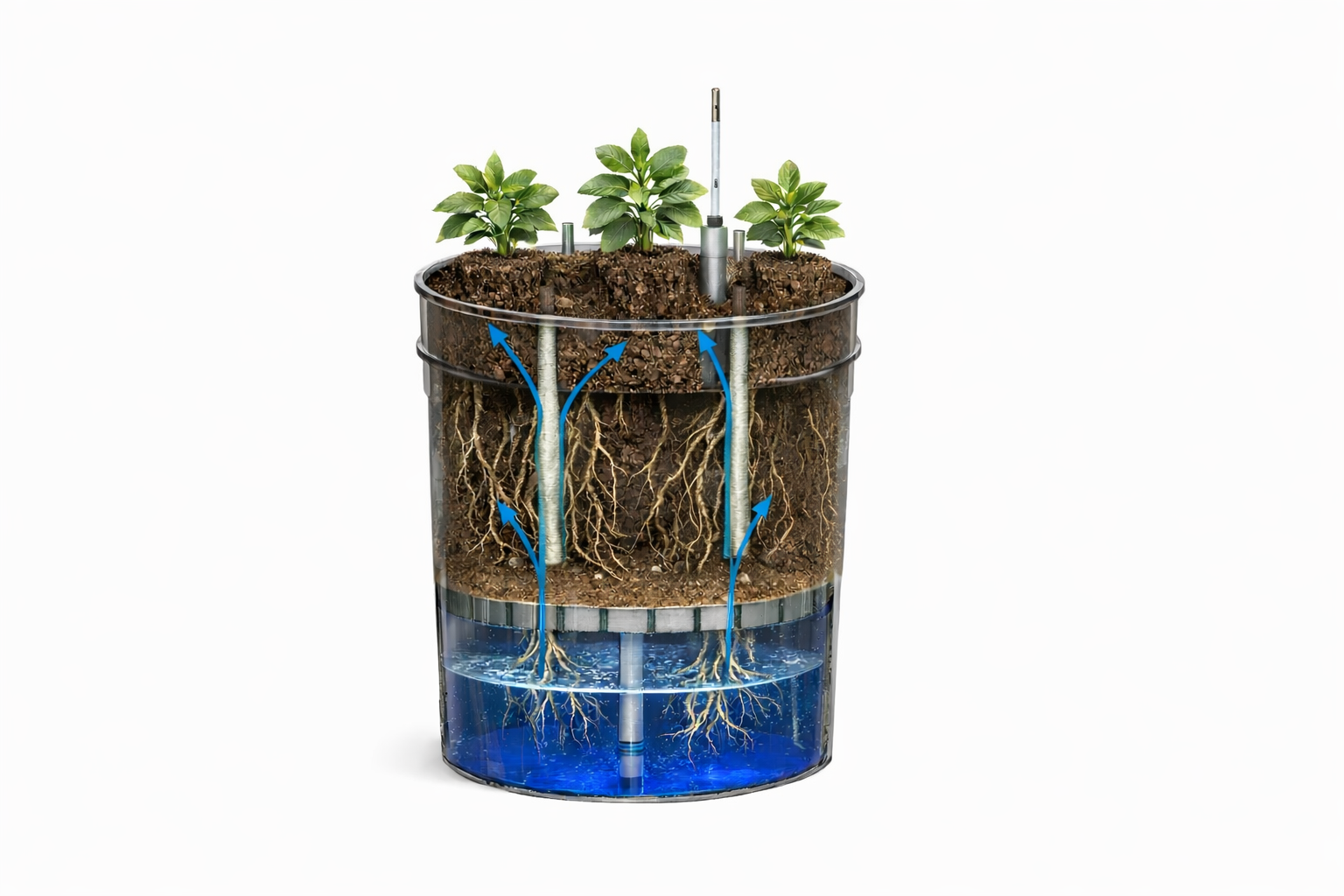
How the Bucket Oasis Optimizes Oxygen and Water Together
The Bucket Oasis is designed around this balance.
Key design features:
1) Air Gap Separation
A physical gap between the reservoir and soil prevents full soil saturation.
This helps preserve oxygen-rich zones in the root system.
2) Wick-Based Water Delivery
Water is pulled upward gradually instead of flooding downward.
This avoids sudden displacement of air in the soil.
3) Stable Moisture Profile
Moisture is maintained consistently—often reaching near the upper soil layer—without full saturation.
This allows water availability without eliminating oxygen.
4) Self-Regulated Uptake
Plants draw water based on demand, reducing overwatering events caused by human timing.
Together, this creates:
fewer oxygen depletion events
more stable root conditions
improved nutrient uptake efficiency
What Most People Don’t Realize About Roots in These Systems
In a balanced system:
most roots remain in oxygen-rich soil
some roots may extend toward consistent moisture zones
This creates a functional split:
oxygen-focused roots
water-access roots
Unlike overwatering—where all roots are deprived of oxygen—this system maintains both environments.
Why This Leads to Better Plant Health
When roots consistently have access to both:
water
oxygen
Plants can:
grow continuously instead of in cycles
absorb nutrients more efficiently
resist stress from environmental changes
This is the difference between:
reacting to problems
andmaintaining stability
The Takeaway
Most plant care advice focuses on how much or how often to water.
But the real issue is what that watering does to oxygen in the soil.
Research shows:
roots require oxygen for growth and nutrient uptake
excess water reduces oxygen availability
fluctuating moisture creates repeated stress
The goal isn’t just to water correctly.
It’s to maintain a system where:
→ water and oxygen stay in balance
Because healthy plants don’t just need moisture.
They need a root environment that can breathe—and stay stable over time.
