
Can You Start Seeds in a Self-Watering Container? (Why Most Systems Fail—and What Actually Works)
Starting plants from seed seems simple:
Add soil.
Plant the seed.
Water.
But in reality, seed germination is one of the most sensitive stages in a plant’s life—and it’s where many systems fall short.
The Critical Requirement: Moisture at the Soil Surface
Seeds don’t germinate deep in the soil.
Most seeds sprout within the top:
→ 0 to 1 inch of soil
This zone must stay:
consistently moist
not saturated
not dry between cycles
Research confirms that interruptions in moisture during germination can delay or completely stop seed development.
Source:
https://extension.umn.edu/planting-and-growing-guides/starting-seeds-indoors
Why Most Self-Watering Containers Struggle With Seeds
Traditional self-watering systems rely on:
a bottom reservoir
upward moisture movement
But they typically create a gradient:
wet at the bottom
progressively drier toward the top
This creates a problem:
The germination zone (top layer) often:
dries out too quickly
requires manual top watering
becomes inconsistent
As a result, most systems still require:
→ daily or frequent surface watering during early growth
The Physics Behind It: Capillary Action Limits
Water moves upward through soil via capillary action.
But this movement depends on:
soil structure
pore size
moisture continuity
Research shows that capillary rise is limited and often insufficient to fully saturate upper soil layers in typical container conditions.
Source:
https://www.fao.org/3/r4082e/r4082e.pdf
This is why many bottom-watering systems don’t support germination on their own.
What Actually Works for Seed Germination
For seeds to reliably sprout, the system must provide:
consistent moisture near the surface
minimal drying cycles
stable conditions over several days
This is why traditional methods rely on:
misting
humidity domes
frequent watering
All of which increase effort and variability.
Where Most Systems Fall Short
Even well-designed self-watering containers:
don’t fully hydrate the top layer
depend on roots reaching deeper moisture
require manual intervention early on
This creates a gap between:
germination stage
established plant stage
How the Bucket Oasis Changes This
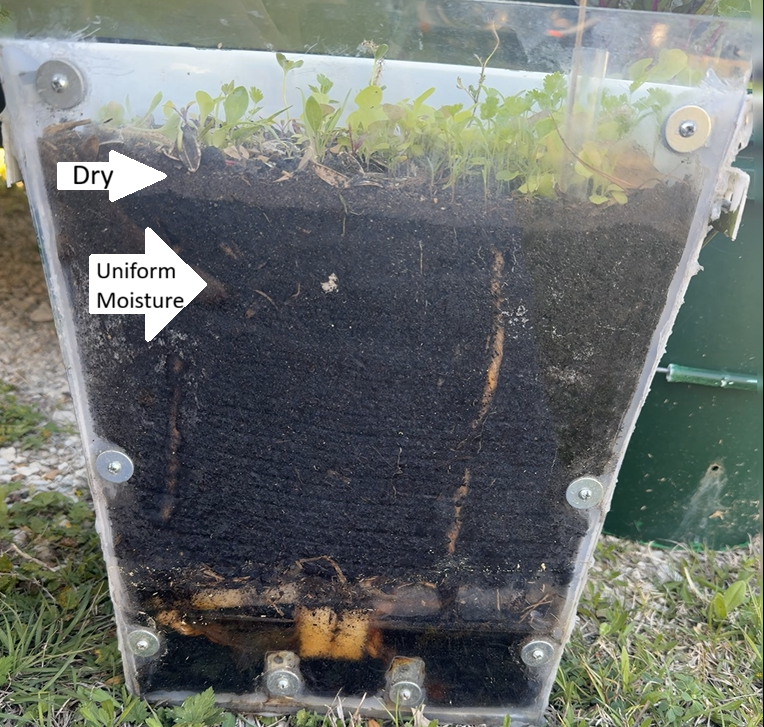
The Bucket Oasis has been observed to maintain moisture:
→ within approximately 1/4 inch of the soil surface (without mulch)
This is significant because it reaches into the active germination zone.
By using:
a continuous water reservoir
multiple wick نقاط distributing moisture
the system:
reduces vertical moisture gaps
keeps upper soil layers more consistently hydrated
minimizes the need for daily top watering
What This Means for Seed Starting
With more consistent surface moisture:
seeds are less likely to dry out
germination becomes more reliable
fewer manual watering cycles are needed
This allows the system to function more like:
a passive germination environment
rather thana manually maintained one
Important Clarification
This does not mean:
zero monitoring is required
all seeds will perform identically
Factors like:
light
temperature
seed type
still play a role.
But it does reduce one of the biggest failure points:
→ inconsistent surface moisture
Why This Matters (Especially for Beginners)
Seed starting typically fails because:
the surface dries out
watering is inconsistent
timing is missed
By stabilizing moisture in the top layer:
the system removes a major source of error
reduces daily maintenance
improves success rates
The Takeaway
Most self-watering systems are designed to support established plants—not seeds.
The difference comes down to one detail:
→ whether moisture reaches the top layer consistently
Research shows that:
germination depends on stable moisture
capillary limits often prevent this
inconsistent watering leads to failure
A system that maintains moisture closer to the surface bridges that gap.
And when that happens, seed starting becomes less about timing—and more about stability.
