
Consistent watering beats “perfect” watering (with data links)
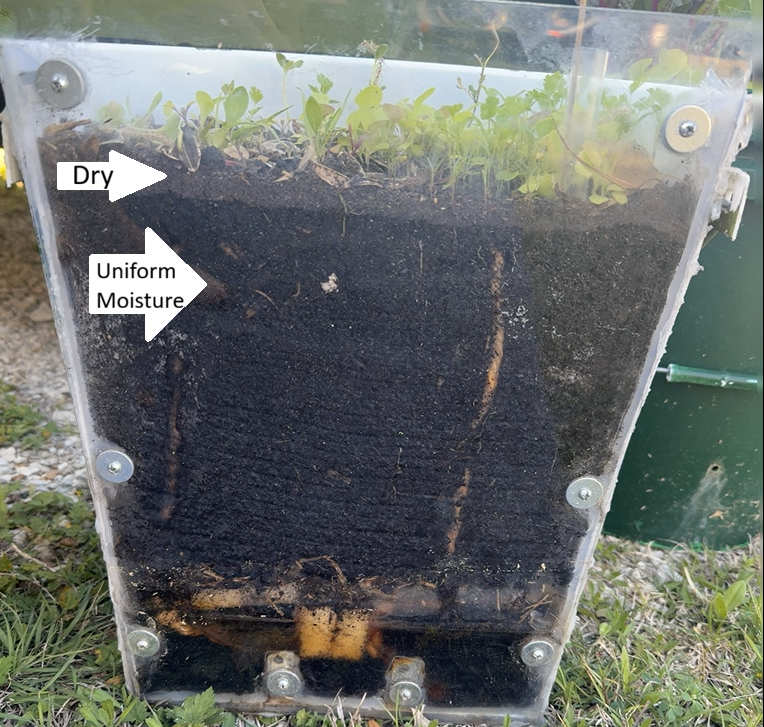
Oasis Cross Section
Most people assume healthy plants come from watering at the right time, in the right amount, every time.
But research shows something different:
Plants don’t need perfect watering.
They need consistent moisture.
And the difference between those two approaches is measurable.
What studies show about moisture consistency
Controlled irrigation research consistently shows that stable root-zone moisture leads to better plant performance.
When moisture fluctuates:
Plants enter repeated stress cycles
Growth slows between watering events
Nutrient uptake becomes inconsistent
When moisture is stable:
Growth becomes continuous instead of stop-and-start
Root systems develop more evenly
Water is used more efficiently
Supporting research:
ASHS HortTechnology (wick substrate water stabilization): https://journals.ashs.org/view/journals/horttech/17/1/article-p62.xml
FAO irrigation principles (soil moisture consistency): https://www.fao.org/3/i2800e/i2800e.pdf
Quantitative results from wick irrigation systems
Multiple peer-reviewed and field studies show measurable improvements when using wick or controlled irrigation systems:
54.6% increase in tomato yield and 82.4% reduction in water use
Source: https://www.sciencedirect.com/science/article/pii/S0378377422004747Up to 164% increase in yield and water-use efficiency (mung bean)
Source: https://onlinelibrary.wiley.com/doi/10.1002/ird.2924Up to ~100% improvement in water productivity depending on system design
Source: https://agris.fao.org/search/en/providers/126158/records/68b691d668d9e68067001ee6Wick irrigation maintains continuous moisture availability at the root zone, reducing plant water stress
Source: https://www.researchgate.net/publication/365130237_Wick_Irrigation_a_water_conserving_irrigation_technique_for_small_areas
These are significant improvements—and they consistently point to one factor:
continuous water availability.
Why human watering underperforms
Manual watering introduces variability by design.
Even with good habits:
Water is applied in bursts
Soil alternates between saturated and dry
Timing rarely matches plant demand
This leads to inefficiencies:
Water loss through drainage and evaporation
Temporary oxygen deprivation after heavy watering
Growth slowdowns during dry periods
The result is a stop-and-start growth cycle instead of steady development.
Why wick systems perform better
Wick irrigation systems change how water is delivered:
Water is continuously available in a reservoir
It moves upward through capillary action
Plants draw water based on demand
Because of this:
Soil moisture stays within a narrower range
Roots avoid stress from extremes
Growth becomes more consistent
Supporting reference:
Where the Bucket Oasis fits
The Bucket Oasis operates on the same principles supported in these studies:
A reservoir provides continuous water supply
Cotton wicks regulate delivery into the soil
Soil distributes moisture outward
Plants control their own intake
This places it closer to:
controlled irrigation systems
wick-based irrigation methods studied in research
…and farther from:
inconsistent, manual watering cycles
Is it fair to compare Oasis to “optimal watering”?
In agriculture, optimal watering often uses sensors and automation.
But what those systems actually control is: consistency.
The studies above show that when consistency is achieved:
yields can increase by 50% or more
water efficiency can improve by up to 100%+
water usage can drop by up to 80%
The Bucket Oasis achieves that same consistency—passively.
No timers.
No sensors.
No daily decisions.
For most plant owners, that makes it one of the closest practical ways to approach optimal watering conditions.
The takeaway (with numbers that matter)
The difference between manual watering and consistent watering isn’t subtle—it’s measurable.
Research-backed systems that stabilize moisture can:
increase yields by 50–160%
improve efficiency by up to 100%+
reduce water usage by up to 80%
The challenge has never been knowing what plants need.
It’s maintaining those conditions consistently.
The Bucket Oasis solves that problem at the system level.
And that’s what plants respond to.
