
The Physics of Water in Soil
Most plant care advice focuses on the top of the pot. Pour water in, let gravity take it down. Easy enough — except it's the wrong mental model. The moment water enters soil, it stops obeying the simple rules of gravity alone and enters a world governed by surface tension, adhesion, cohesion, and capillary pressure. Understanding those forces doesn't just satisfy scientific curiosity — it fundamentally changes how, and from where, you water.
This is a deep dive into what soil actually does with water. We'll cover the core physics, the numbers that define plant-available moisture, and why Bucket Oasis sub-irrigation planters are designed to work with these physical laws rather than against them.
1. Capillary Action: The Force Nobody Talks About
You already know water flows downhill. What you may not know is that in soil, water also flows uphill — continuously, silently, and without any pump. This is capillary action, and it is the dominant force governing how moisture moves through the plant root zone.
"Capillary action reflects the forces that hold water in unsaturated soil against the action of gravity and give rise to spontaneous flow towards evaporating surfaces or plant roots." — ScienceDirect Topics: Capillarity, Earth and Planetary Sciences [1]
Capillary action arises from two competing molecular forces: adhesion (water molecules clinging to soil particle surfaces) and cohesion (water molecules clinging to each other). When adhesion to the solid surface is stronger than the cohesive force within the liquid itself, water is pulled upward into tiny pore spaces — the narrower the pore, the higher it climbs. [2]
The USGS explains it this way: capillary action is "the movement of water within the spaces of a porous material due to the forces of adhesion, cohesion, and surface tension." It is responsible for moving groundwater from wet areas of the soil to dry areas without any outside energy input. [3]
The Young–Laplace Equation: The pressure driving capillary rise is calculated as Pc = 2σ/R, where Pc is capillary pressure, σ is the surface tension of water (≈ 0.0728 N/m at 20°C), and R is the pore radius. As pore radius decreases, capillary pressure increases — this is why fine-textured soils draw water higher and hold it more strongly than coarse ones. [1]
How Soil Texture Transforms Capillary Behavior
Not all soils are equal in their capillary power. According to Sensoterra's soil science research, capillary action differs dramatically by texture: [4]
• Sandy soils — large particles, wide pore spaces — have limited capillary action. Water drains gravitationally and their water-holding capacity is low.
• Clay soils — fine particles, tiny pore spaces — have very strong capillary action and retain moisture for extended periods against gravity.
• Silt and loam soils occupy the productive middle ground: strong enough capillary retention to hold moisture, open enough pore structure to supply plants efficiently.
Drainage vs. Retention: The Numbers That Define the Root Zone
The physics of soil water is best understood through three precisely-measured thresholds. Between these three states lies all the moisture that matters to your plant.
Field Capacity: 10–40% volumetric water content, varying from sandy to clay soils. Typical soil matric potential: −33 kPa in loam soils. [5]
Permanent Wilting Point: Matric potential of −1,500 kPa — the hard limit of plant water extraction. [6]
Plant Available Water (PAW): The gap between field capacity and wilting point — the only moisture that actually counts.
Saturation is when all pore spaces are filled with water. Field capacity is reached 1–3 days after saturation, once gravity has drained the large macropores — this is the upper limit of plant-useful moisture. [7] Permanent wilting point is when the remaining water is held so tightly by capillary and adhesive forces that roots can no longer extract it. [6]
According to Oklahoma State University Extension, field capacity in sandy soils sits at roughly 20% volumetric water content, while clay soils can reach 40%. Wilting point in sandy soils drops to 5–10%, while in clay soils it can be 15–20%. [5][8] About half of the water present in soil at field capacity is held too tightly for plant roots to access. As METER Group states: "About half of the water in the soil at field capacity is held too tightly to be accessible to plants." [6]
"A plant transpiring at the rate of 0.25 inches per day will start showing stress symptoms within four days if no rainfall occurs — even in soil that still appears moist to the touch." — Cornell University, Competency Area 2: Soil Hydrology [8]
Drainage: When Gravity Wins
Above field capacity, water occupies the large macropores and is subject to free gravitational drainage before most plants can use it. According to Nature Education's Soil Water Dynamics review: "Water held between saturation and field capacity is transitory, subject to free drainage over short time periods, hence it is generally considered unavailable to plants." [9]
When you pour excess water from the top of a pot, a significant portion passes straight through in this gravitational drainage phase — leaving the surface looking moist while the deeper root zone may remain unsatisfied. This is a direct consequence of pore physics, not user error.
3. Why Top Watering Is Inherently Inconsistent
With the physics clear, the problem with conventional top watering comes into focus. It isn't simply that people water "too much" or "too little." The method itself creates a structural inconsistency in how moisture distributes through the soil profile.
The core problem: Top watering saturates the uppermost centimeters of soil first. Capillary forces then work against the downward movement of water, retaining moisture near the surface. Deeper root zones — where the bulk of a mature plant's absorptive roots live — may remain below field capacity even after a thorough-seeming top watering.
Irrigation expert Sean Lade, director of Easy Garden Irrigation, identifies this precisely: "The aim is to encourage deep water penetration, ensuring moisture reaches the entire root system." He notes that shallow top watering "just wets the surface and leads to weak roots." [10]
Research from Konzept Garden summarizes the practical consequence: "When you water from the top, the first inch of soil gets soaked while deeper layers stay dry. Your plant responds by pushing shallow roots toward the surface to catch that moisture before it evaporates." [11] This creates a feedback loop — shallow roots become more dependent on the inconsistent top-down cycle, weakening the plant's overall resilience.
The Boom-and-Bust Moisture Cycle
Greenery Unlimited's horticultural team describes what happens over time with typical top-watering routines: "We get busy and forget to water one week, and the next overcompensate. We then realize a week later that the soil is still very wet and we have overwatered, so we withhold water for another week, and a bad cycle emerges." [12]
The University of Maryland Extension confirms the physiological consequences: "Excess water reduces oxygen in the soil, which damages fine roots and renders the plant unable to take up water" — producing drought symptoms in an overwatered plant. [13] Overwatered roots produce the same wilting symptoms as drought-stressed ones, making top watering doubly difficult to calibrate.
Key statistics: Overwatering is the most common cause of houseplant death. [12] A sandy-soil plant under normal transpiration can hit wilting-point stress in just 2–4 days. [8] By contrast, sub-irrigation reservoir systems typically deliver 7–14 days of consistent hydration. [14]
4. How Sub-Irrigation Works With Soil Physics
Sub-irrigation — delivering water from a reservoir below the root zone — is not a modern gardening gimmick. It mirrors exactly how water moves in nature. As Greenery Unlimited explains: "When it rains, the soil absorbs the moisture and gravity draws the water to the lower levels of soil. As the top layers dry out, the plant's deep root systems are still able to draw water from the water reserves below." [12]
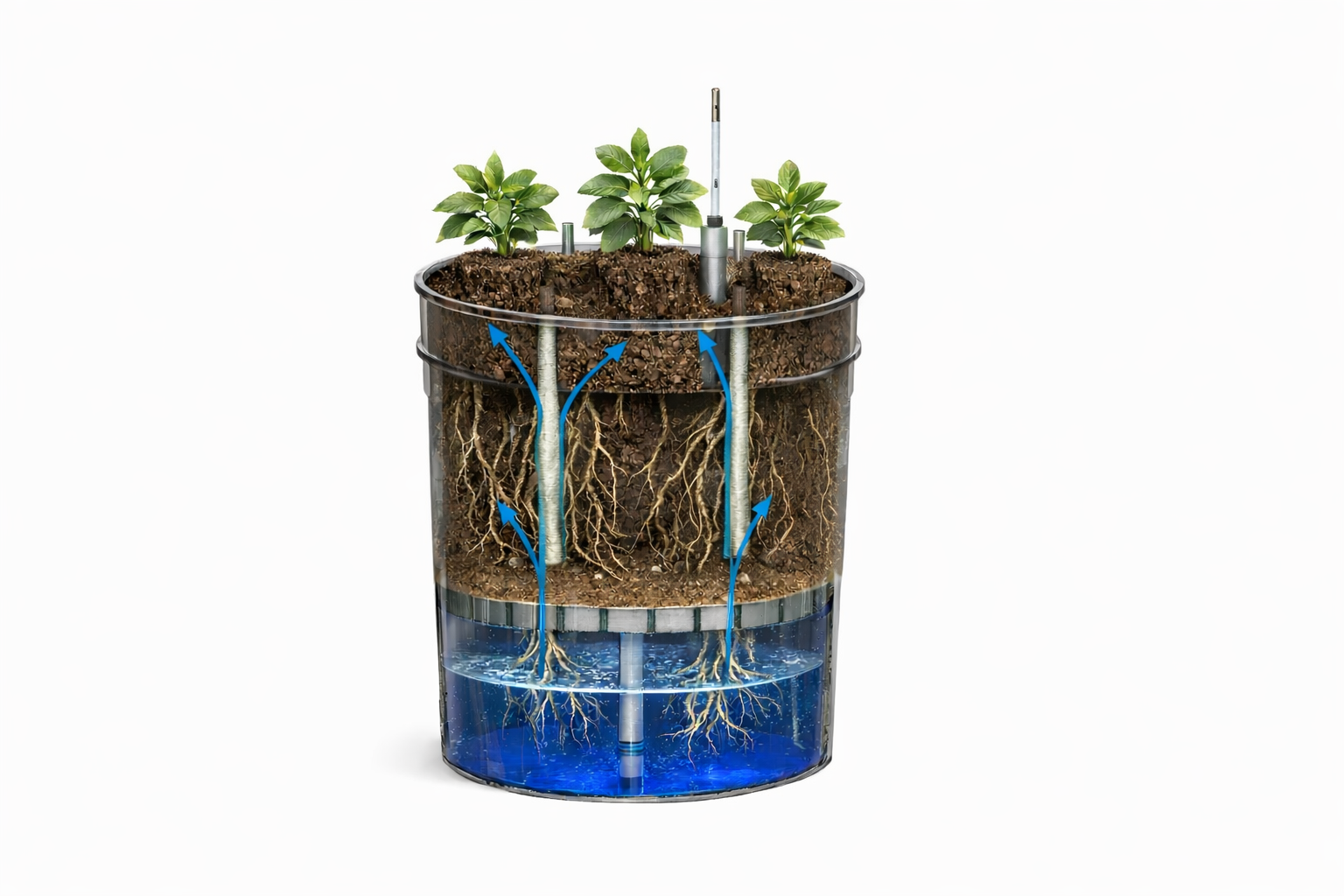
A sub-irrigation system places a water reservoir at the base of the planter. The soil above draws moisture upward via capillary action — the same physical mechanism that moves groundwater through natural soil profiles. Crucially, the plant controls the rate: as roots extract moisture, matric potential drops slightly, which drives capillary movement from the wetter reservoir upward into drier soil. The system self-regulates.
"Bottom watering, based on capillary action, draws roots deeper for moisture, fostering a healthier root system while reducing foliar disease risk by keeping leaves dry." — Sean Lade, Director, Easy Garden Irrigation [10]
Root & Vessel's product team describes the biological consequence: "Bottom-up watering encourages roots to grow downward toward moisture instead of staying near the surface. This creates a more stable, resilient plant with better access to water and nutrients." [15]
How Bucket Oasis Naturally Solves This
Bucket Oasis planters are engineered around the physics described in this post. A built-in water reservoir at the base feeds moisture upward through capillary action — directly to the root zone, on demand, at the rate the plant sets. There is no boom-and-bust cycle, no surface saturation, and no guessing.
Your plant draws exactly what it needs, exactly when it needs it — maintaining the productive moisture band between field capacity and wilting point, consistently and passively. This is not a convenience feature. It is a physics-informed solution to a structural problem with how potted plants have traditionally been watered.
5. The Practical Takeaway
Soil physics isn't abstract theory. Every watering decision either aligns with these forces or works against them. Here's what the science tells us:
• Capillary action is always working. Soil is constantly redistributing moisture from wetter zones to drier zones. A planter that places water below the root zone cooperates with physical reality. Top watering fights it.
• The useful moisture window is narrow. Plant-available water exists only between field capacity (~−33 kPa) and the permanent wilting point (~−1,500 kPa). Maintaining soil within this band requires consistency that manual top watering rarely delivers.
• Top-down watering creates vertical moisture gradients. Upper layers get saturated; deeper layers may remain sub-optimal. Roots adapt by staying shallow — making them more vulnerable to the next watering inconsistency.
• Sub-irrigation inverts the problem. By supplying moisture at the base and allowing capillary forces to distribute it upward on demand, sub-irrigation keeps the entire root zone in the productive moisture band — consistently, passively, and without daily intervention.
References & Sources
1. ScienceDirect Topics — Capillarity, Earth and Planetary Sciences. https://www.sciencedirect.com/topics/earth-and-planetary-sciences/capillarity
2. Encyclopedia.com — Capillary Action. Adhesion, cohesion, and surface tension in soil pores. https://www.encyclopedia.com/earth-and-environment/ecology-and-environmentalism/environmental-studies/capillary-action
3. U.S. Geological Survey (USGS) — Capillary Action and Water. Water Science School. https://www.usgs.gov/special-topics/water-science-school/science/capillary-action-and-water
4. Sensoterra — Soil Texture's Influence on Water Capillary Function. https://www.sensoterra.com/news/soil-texture-influence-on-water-capillary-function/
5. Oklahoma State University Extension — Understanding Soil Water Content and Thresholds for Irrigation Management. https://extension.okstate.edu/fact-sheets/understanding-soil-water-content-and-thresholds-for-irrigation-management.html
6. METER Group — Plant Available Water: How Do I Determine Field Capacity and Permanent Wilting Point? https://metergroup.com/measurement-insights/plant-available-water-how-do-i-determine-field-capacity-and-permanent-wilting-point/
7. SDSU Extension — How Soil Holds Water. https://extension.sdstate.edu/how-soil-holds-water
8. Cornell University / NRCCA — Competency Area 2: Soil Hydrology. https://nrcca.cals.cornell.edu/soil/CA2/CA0212.1-3.php
9. Nature Education / Scitable — Soil Water Dynamics. https://www.nature.com/scitable/knowledge/library/soil-water-dynamics-103089121/
10. Homes & Gardens — Should You Water Plants from the Top or Bottom? Sean Lade, Easy Garden Irrigation. https://www.homesandgardens.com/gardens/should-you-water-plants-from-the-top-or-bottom
11. Konzept Garden — How Do Self Watering Planters Work? Capillary Action Guide. https://konzeptgarden.com/blogs/news/how-do-self-watering-planters-work
12. Greenery Unlimited — What Are Self Watering Planters and How Do They Work? https://greeneryunlimited.co/blogs/plant-care/what-are-self-watering-planters
13. University of Maryland Extension — Overwatered Indoor Plants. https://extension.umd.edu/resource/overwatered-indoor-plants
14. Six Storeys — Best Self-Watering Planters Review. https://sixstoreys.com/best-self-watering-planters/
15. Root & Vessel — What Is a Self-Watering Planter. https://rootandvessel.com/blog/what-is-a-self-watering-planter
