
How Many Wicks Should You Use? The Science Behind Wick Count, Container Size, and Soil Moisture
"How many wicks do I need?"
The answer surprises many people.
In most cases:
→ More wicks do not mean wetter soil.
Instead, additional wicks primarily improve:
moisture distribution
hydration uniformity
water availability throughout the root zone
This is an important distinction because many gardeners worry that adding extra wicks will overwater their plants.
In reality, the relationship between wick count and soil moisture is much more nuanced.
The Biggest Myth About Wick Systems
Many people assume:
More wicks = wetter soil
This is only partially true.
Wicks do not actively pump water into the soil.
They simply create pathways that allow water to move upward through capillary action.
Roots still determine how much water is ultimately removed from the soil.
Think of wicks like adding additional roads to a city.
More roads improve transportation.
They don't force people to drive more.
Similarly:
More wicks improve water availability.
They don't force roots to absorb more water than they need.
Research on capillary movement and soil-water relationships shows that water moves through soil until gravity, capillary forces, evaporation, and plant uptake reach equilibrium.
Source:
https://extension.okstate.edu/fact-sheets/capillary-water-and-soil-moisture.html
What Wicks Actually Do
The primary function of a wick is to:
transport water upward
distribute moisture laterally
maintain hydraulic continuity between the reservoir and root zone
In practical terms:
Additional wicks help prevent situations where:
one side of the container stays moist
the opposite side dries out
The larger the container becomes, the more important this distribution effect becomes.
Why Three 3/8-Inch Cotton Wicks Work So Well
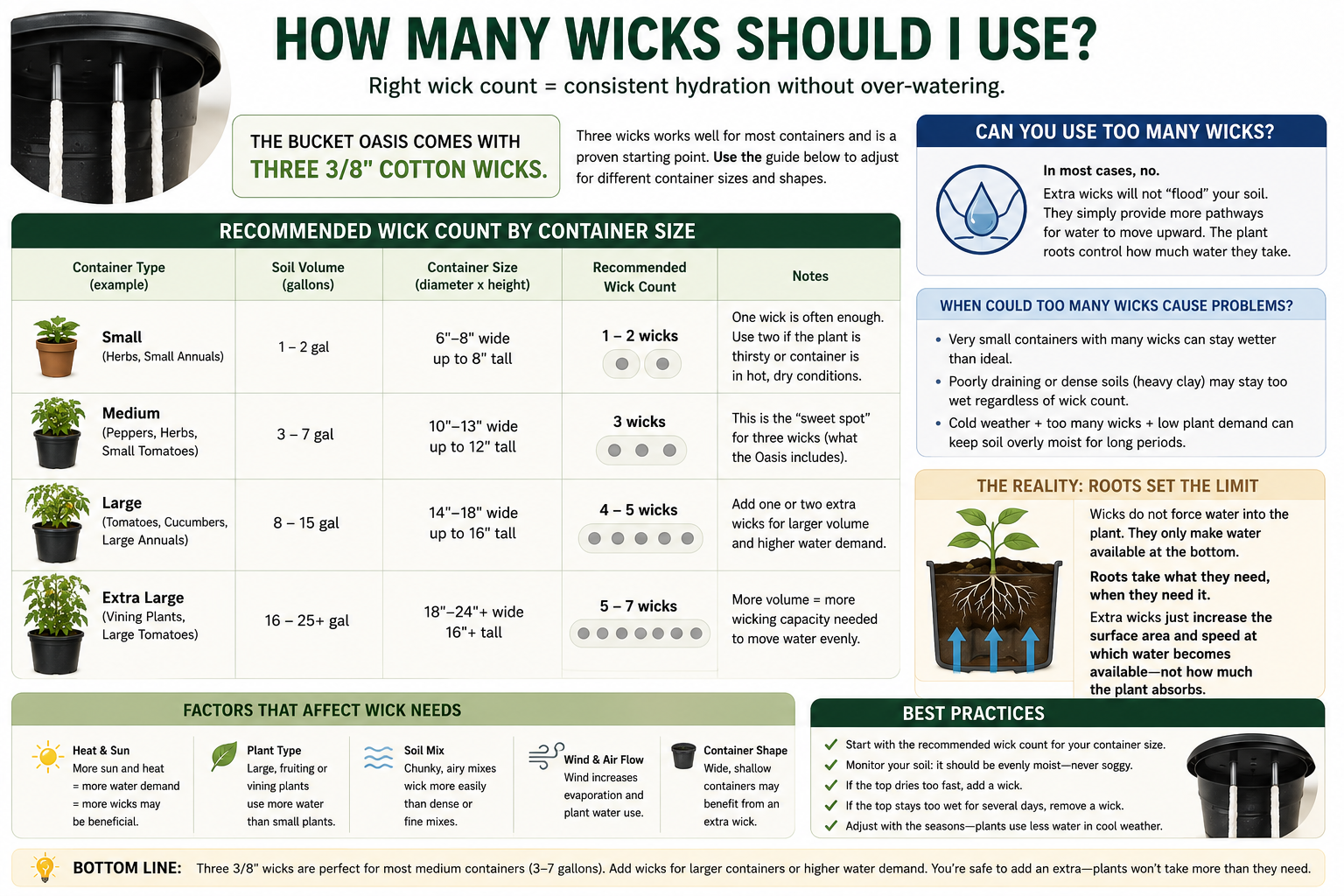
The standard Oasis configuration uses:
three 3/8-inch cotton wicks
For most containers between:
3 and 7 gallons
this provides an excellent balance between:
moisture delivery
moisture distribution
simplicity
Three wicks create multiple moisture columns throughout the container.
Instead of relying on a single central wick, moisture can spread more evenly across the root zone.
Based on Oasis testing and observed moisture distribution patterns, three evenly spaced 3/8-inch cotton wicks provide uniform moisture coverage for the majority of common container sizes used by home gardeners.
Wick Spacing May Matter More Than Wick Count
One of the most overlooked aspects of wick systems is spacing.
Three wicks clustered together are often less effective than three wicks spread evenly throughout the container.
Why?
Water moves vertically through a wick much faster than it moves horizontally through potting soil.
Research on capillary movement shows that horizontal moisture movement is limited by:
soil texture
organic matter
pore size
soil density
Source:
https://extension.okstate.edu/fact-sheets/capillary-water-and-soil-moisture.html
As a result:
A 12-inch diameter container with three evenly spaced wicks will often hydrate more uniformly than the same container with all three wicks grouped in the center.
Can You Use Too Few Wicks?
Absolutely.
Too few wicks is often associated with uneven moisture distribution.
Common symptoms include:
dry zones between wicks
uneven root growth
roots clustering near moisture sources
unused reservoir water
localized drought stress
Research has shown that roots naturally grow toward moisture gradients, a phenomenon known as hydrotropism.
Source:
https://www.nature.com/articles/nplants201557
When only a small portion of the container receives consistent moisture, roots frequently concentrate near those areas rather than fully utilizing the available soil volume.
Can You Use Too Many Wicks?
Under most conditions:
Not easily.
Adding additional wicks generally does not flood the soil.
Instead it increases:
moisture distribution
reservoir access
hydration uniformity
However, there are exceptions.
Situations Where Too Many Wicks Can Create Problems
Very Small Containers
A 1-gallon container with:
three large wicks
dense potting mix
cool temperatures
may remain wetter than ideal.
The soil volume is simply too small to benefit from extensive wick coverage.
Heavy Soils
Containers filled with:
topsoil
clay-rich soil
compacted mixes
already retain excessive water.
Additional wicks may worsen the problem.
This is not caused by the wick itself.
It is caused by poor soil structure and limited aeration.
Cool Weather and Low Water Demand
During:
spring
fall
indoor winter growing
plants consume less water.
Additional wicks may keep soil near field capacity longer than necessary.
What Happens in Well-Draining Potting Mixes?
This is where most container gardeners operate.
When using:
quality potting mixes
bark-based media
compost blends
perlite-amended soils
additional wicks generally improve:
moisture consistency
root access to water
reservoir utilization
without creating saturated conditions.
In these situations, roots often colonize the container more evenly because moisture is available throughout a larger portion of the soil profile.
How Container Size Affects Wick Requirements
As containers increase in size:
two things happen:
Water must travel farther horizontally.
More roots compete for available moisture.
Both increase the value of additional wicks.
Recommended Wick Counts by Container Size
The following recommendations are based on Oasis testing, wick diameter, moisture distribution patterns, and common container gardening practices.
Container VolumeTypical UseRecommended Wicks1–2 gallonsHerbs, small flowers1–2 wicks3–7 gallonsPeppers, herbs, dwarf vegetables3 wicks8–15 gallonsTomatoes, cucumbers, annual flowers4–5 wicks16–25 gallonsLarge vegetables, vines5–7 wicks25+ gallonsLarge planters and raised containers6–10+ wicks
These are engineering recommendations rather than published scientific standards.
Container Shape Matters Too
Two containers may both hold:
10 gallons
but behave very differently.
Tall Narrow Containers
Water travels upward more easily.
Often require fewer wicks.
Wide Shallow Containers
Water must spread farther horizontally.
Often benefit from additional wick locations.
This is another reason wick placement frequently matters more than total wick count.
Large Fruiting Plants Have Different Demands
Plants differ dramatically in water consumption.
Lower Demand Plants
basil
thyme
oregano
succulents
Often perform well with fewer wicks.
Higher Demand Plants
tomatoes
cucumbers
squash
melons
can benefit significantly from increased moisture distribution.
University Extension watering guides show that mature vegetable crops may require substantial water inputs during peak summer production.
Sources:
https://extension.umd.edu/resource/watering-vegetables
https://extension.umn.edu/growing-systems/watering-vegetables
Providing multiple moisture pathways helps reduce localized drying and allows roots to access water more uniformly throughout the container.
The Hidden Benefit of Extra Wicks
Most gardeners think:
"Extra wicks add more water."
But the larger benefit is often:
More uniform root development.
Research on hydrotropism shows roots actively grow toward moisture sources.
Source:
https://www.nature.com/articles/nplants201557
When moisture is evenly distributed:
roots spread throughout the container.
When moisture is uneven:
roots tend to concentrate around water sources.
More complete root coverage often means:
improved nutrient uptake
greater drought resistance
more efficient use of container volume
Understanding Moisture Equilibrium
One of the most fascinating aspects of wick systems is that they naturally seek equilibrium.
Water moves upward until:
gravity
capillary forces
evaporation
plant uptake
reach balance.
Additional wicks help more of the container reach that balance.
They do not necessarily make the entire container wetter.
They simply help more of the container achieve a similar moisture level.
Source:
https://extension.okstate.edu/fact-sheets/capillary-water-and-soil-moisture.html
How To Know If You Need More Wicks
Consider adding wicks if:
dry zones develop
roots cluster around existing wicks
one side of the container dries faster
plants wilt despite water remaining in the reservoir
How To Know If You May Have Too Many Wicks
Consider reducing wick count if:
soil remains saturated for extended periods
plants show signs of oxygen stress
roots appear brown or unhealthy
soil develops anaerobic odors
In quality potting mixes, these situations are relatively uncommon.
What This Means for Oasis Users
The standard Oasis configuration of three 3/8-inch cotton wicks was selected because it performs well across the majority of common container sizes.
For most gardeners:
three wicks provide an excellent starting point.
As container size increases, additional wicks can improve moisture distribution and root-zone uniformity.
The goal is not maximum water movement.
The goal is uniform moisture availability throughout the container.
The Takeaway
Most gardeners worry about using too many wicks.
In reality, uneven moisture distribution is often a larger concern than excessive wick count.
Wicks do not force water into the plant.
They simply make water available.
The plant still controls how much it uses.
For most containers:
1–2 wicks work well for small pots
3 wicks are ideal for medium containers
4–7 wicks benefit larger vegetables and planters
The best wick count is the one that creates:
uniform moisture
healthy roots
consistent growth
without leaving dry zones or saturated pockets.
In a well-designed self-watering container, additional wicks often improve moisture distribution far more than they increase soil wetness.
References
Capillary Water and Soil Moisture – Oklahoma State University
https://extension.okstate.edu/fact-sheets/capillary-water-and-soil-moisture.html
Hydrotropism in Plant Roots – Nature Plants
https://www.nature.com/articles/nplants201557
Watering Vegetables – University of Minnesota Extension
https://extension.umn.edu/growing-systems/watering-vegetables
Watering Vegetables – University of Maryland Extension
https://extension.umd.edu/resource/watering-vegetables
Subirrigation Review (Water Journal)
https://www.mdpi.com/2073-4441/12/5/1313
