
How Much Soil Does a Plant Really Need? The Truth About Container Depth, Root Space, and Self-Watering Systems
One of the first questions gardeners ask after seeing the Bucket Oasis is:
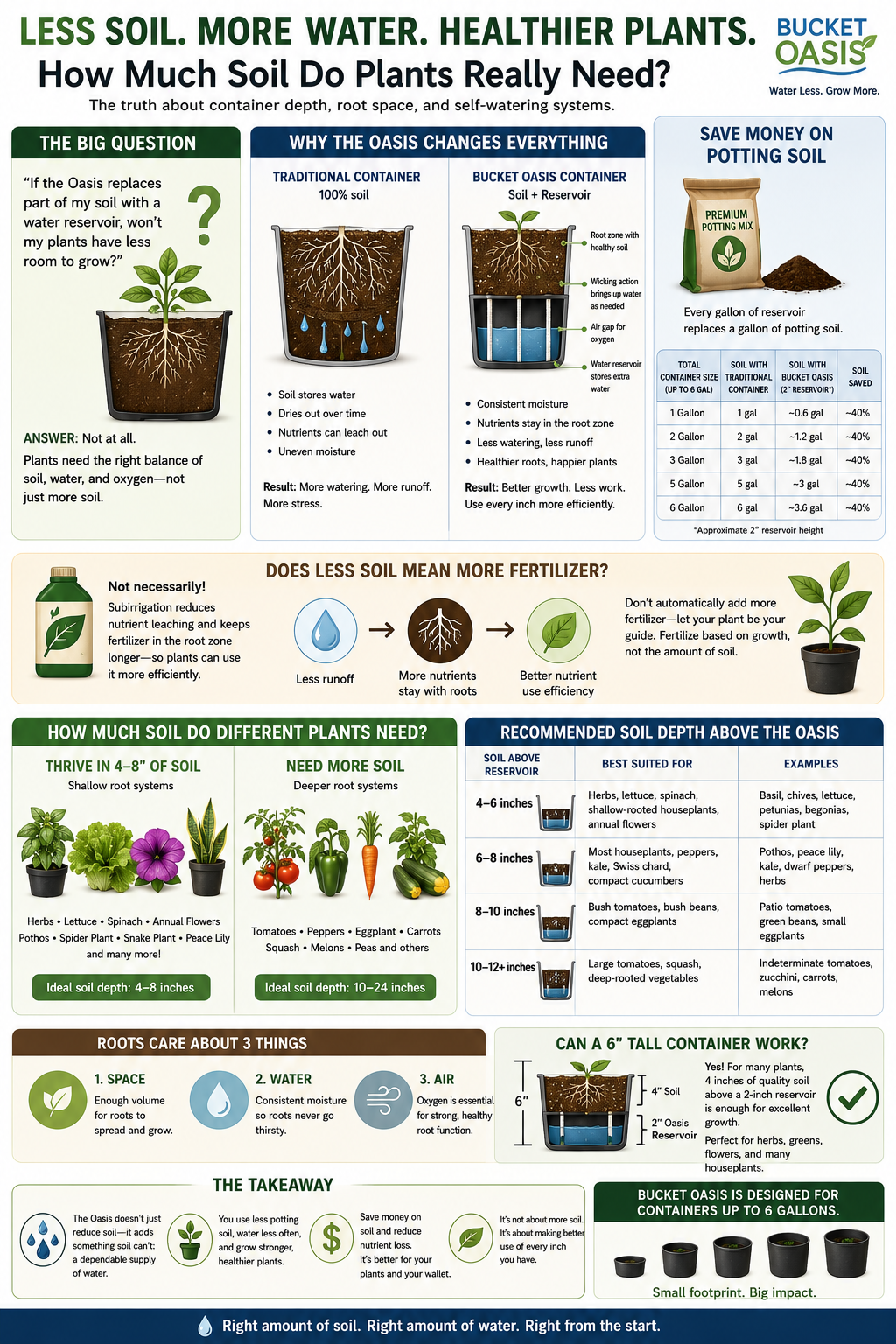
"If the Oasis replaces part of my soil with a water reservoir, won't my plants have less room to grow?"
It's a fair question.
After all, soil holds:
roots
nutrients
beneficial microbes
Why would you want less of it?
The answer is that plants don't simply need more soil.
They need the right amount of soil combined with a reliable supply of water and oxygen.
For many container-grown plants, the Bucket Oasis replaces soil that primarily stores water with a dedicated water reservoir—while leaving enough soil above for healthy root development.
In many cases, this tradeoff not only reduces watering frequency, but also saves money on potting mix.
An Unexpected Benefit: Using Less Potting Soil
Quality potting mix is one of the largest recurring expenses in container gardening.
Premium mixes commonly cost:
$8–15 per cubic foot
$15–30 for premium specialty blends
By replacing a portion of the container with a water reservoir, the Oasis also reduces the amount of potting soil required.
For example, in a typical 5-gallon bucket:
Traditional ContainerWith Bucket Oasis~5 gallons of potting mix~3 gallons of potting mix + ~2-gallon water reservoir
That's approximately:
40% less potting soil
without increasing the size of the container.
For gardeners planting multiple containers each season, the savings in potting soil alone can become significant.
More importantly, the reservoir stores something that ordinary potting soil eventually loses:
usable water.
Does Less Soil Mean More Fertilizer?
Not necessarily.
This is one of the biggest misconceptions about self-watering containers.
Less soil does contain fewer nutrients initially.
However, traditional containers also lose nutrients every time excess water drains out of the bottom.
Research on subirrigation systems has shown they often reduce nutrient leaching because water is supplied from below instead of repeatedly flushing fertilizer through the soil profile.
As a result:
more fertilizer remains available to plant roots
less nutrient runoff occurs
fertilizer-use efficiency often improves
Source:
Subirrigation nutrient management review:
https://www.mdpi.com/2311-7524/8/5/370
This doesn't mean every Oasis container requires less fertilizer.
It means gardeners should avoid automatically increasing fertilizer simply because less soil is being used.
Instead, let the plant determine when additional nutrients are needed.
Plants Need Root Volume More Than Root Depth
Many gardening articles focus on soil depth.
Research suggests total root volume is usually the more important measurement.
Roots need:
growing space
oxygen
moisture
nutrients
A wider container with adequate soil volume often performs just as well as a deeper container for many shallow-rooted species.
North Carolina State Extension notes that restricting root volume—not simply root depth—reduces plant size, flowering, and fruit production.
Source:
https://content.ces.ncsu.edu/extension-gardener-handbook/18-plants-grown-in-containers
How the Bucket Oasis Changes the Equation
Traditional containers use the entire soil profile to store water.
As the soil dries:
roots lose access to moisture
nutrients become less available
plant stress increases
The Bucket Oasis changes that design.
Instead of using the lower portion of the container to store water inside the soil, it stores water in a dedicated reservoir beneath the root zone.
Capillary wicks then move moisture upward as the soil begins to dry.
This allows much of the remaining soil to stay within an ideal moisture range while also maintaining an air gap beneath the false floor to support oxygen availability.
The result is not simply "less soil."
It is a different allocation of space:
less soil dedicated to water storage
more water stored directly
more consistent moisture
improved root access to both water and oxygen
Can Four Inches of Soil Be Enough?
For many plants...
Yes.
Research from North Carolina State University lists minimum container depths for numerous vegetables.
Several common crops require only:
CropRecommended Soil DepthSpinach4–6 inRadishes4–6 inMustard Greens4–6 inGreen Onions6 inLettuce6–8 inKale8 inSwiss Chard8 in
Source:
https://content.ces.ncsu.edu/extension-gardener-handbook/18-plants-grown-in-containers
This means a shallow decorative planter with approximately 4–6 inches of soil above an Oasis reservoir can successfully support many herbs, leafy greens, flowers, and houseplants.
Which Plants Need More Soil?
Deep-rooted vegetables benefit from larger root zones.
Examples include:
CropRecommended Soil DepthTomatoes12–24 inPeppers12–16 inEggplant12–16 inCarrots10–12 inSquash12–24 in
Source:
https://content.ces.ncsu.edu/extension-gardener-handbook/18-plants-grown-in-containers
These crops will often survive in smaller containers.
However, additional soil volume generally increases:
plant size
flowering
total yield
Root Restriction Doesn't Mean Plant Failure
One of the biggest myths in container gardening is that plants suddenly fail when they don't have enough soil.
Research shows the more common response is simply reduced performance.
Plants become:
smaller
slower growing
less productive
Rather than dying outright.
This is why choosing the correct container size remains important—even with a self-watering system.
Houseplants and Flowers Often Need Less Soil Than You Think
Many popular houseplants naturally grow in shallow organic layers or tree crotches rather than deep mineral soils.
Examples include:
Pothos (4–6 inches)
Spider Plant (4–6 inches)
Philodendron (4–8 inches)
Snake Plant (4–6 inches)
Peace Lily (6–8 inches)
Likewise, many flowering annuals perform exceptionally well with only 6–8 inches of potting mix, including:
Petunias
Marigolds
Calibrachoa
Lobelia
Begonias
Alyssum
For these plants, moisture consistency is often more limiting than additional soil depth.
Practical Recommendations
Soil Above the OasisBest Suited For4–6 inchesHerbs, lettuce, spinach, shallow-rooted houseplants, annual flowers6–8 inchesMost houseplants, peppers, kale, Swiss chard, compact cucumbers8–10 inchesBush tomatoes, bush beans, compact eggplants10–12+ inchesLarge tomatoes, squash, deep-rooted vegetables
The Takeaway
The Bucket Oasis does not simply remove soil.
It replaces part of the container's soil volume with something that traditional containers constantly struggle to provide:
A dependable supply of water.
For many herbs, leafy greens, flowers, and houseplants, 4–6 inches of healthy, consistently moist soil is entirely sufficient for excellent growth.
Larger vegetables still benefit from additional soil volume.
But by reducing the amount of potting mix needed while improving water availability and reducing nutrient losses, the Bucket Oasis helps gardeners use every inch of their container more efficiently.
Sometimes growing better isn't about adding more soil.
It's about making better use of the soil you already have.
References
North Carolina State Extension – Plants Grown in Containers
https://content.ces.ncsu.edu/extension-gardener-handbook/18-plants-grown-in-containers
Subirrigation Nutrient Management Review (Horticulturae)
https://www.mdpi.com/2311-7524/8/5/370
Better Homes & Gardens – Raised Bed Soil Depth Guide
https://www.bhg.com/how-deep-should-a-raised-garden-bed-be-8780185
GrowVeg – Vegetable Root Depth Guide
https://www.growveg.com/guides/vegetable-root-depths-revealed-use-this-guide-to-make-smarter-planting-decisions/
