
How to Tell If a Plant Can Be Grown in a Container: The Science Behind Container-Friendly Plants
Walk through any garden center and you'll see labels like:
Container Variety
Patio Tomato
Perfect for Pots
Great for Containers
But what actually makes a plant "container friendly?"
Why does basil flourish in a small planter while pumpkins struggle?
Why can one tomato produce dozens of fruits in a bucket while another becomes stressed halfway through the season?
Most gardeners assume the answer is:
"Some plants are meant for containers."
That's only partially true.
The real answer is that every plant has certain biological requirements. The better a container can satisfy those requirements, the more likely the plant is to thrive.
The good news is that you don't need to memorize hundreds of plant varieties.
Once you understand the five factors below, you can evaluate almost any plant before buying it.
The Five Questions Every Gardener Should Ask
Instead of asking:
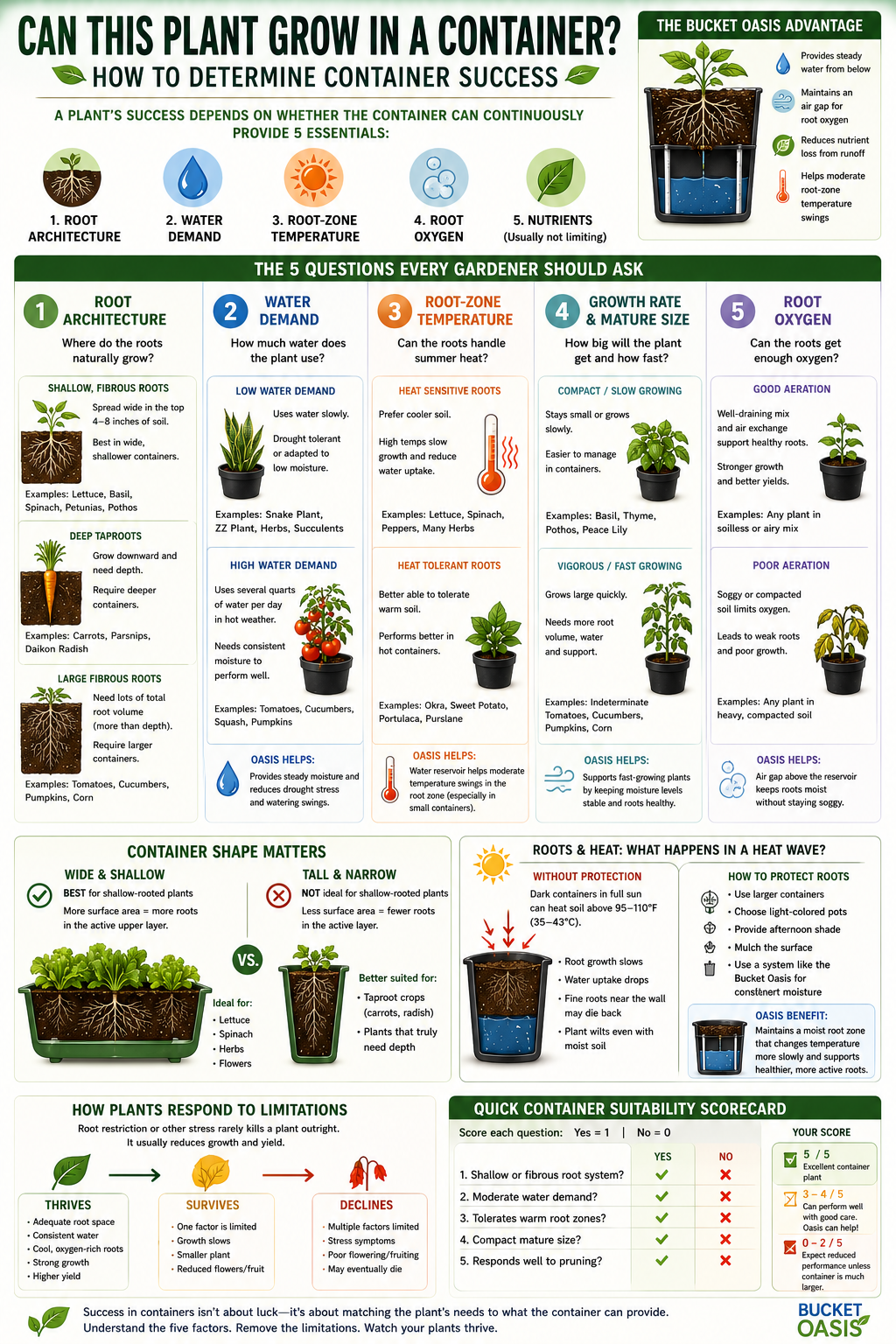
"Can this plant grow in a container?"
Ask:
"Can this container continuously provide what this plant needs?"
Those needs usually come down to five factors:
Root architecture
Water demand
Root-zone temperature
Mature plant size and growth rate
Root oxygen
The Bucket Oasis directly improves two of these and indirectly improves two more.
Let's look at each one.
1. Root Architecture: Does the Plant Grow Wide or Deep?
This is probably the biggest factor that determines container success.
Many gardeners assume deeper containers are always better.
Research shows it depends on how the plant naturally develops its root system.
Shallow, Fibrous Roots
Examples:
Lettuce
Spinach
Basil
Cilantro
Petunias
Pothos
Spider Plant
These plants develop thousands of fine roots throughout the upper portion of the soil.
For them:
A wide container is often more valuable than an extra 6 inches of depth.
More surface area allows more roots to actively absorb:
water
nutrients
oxygen
For example:
A 16-inch-wide planter that is 6 inches deep can often grow considerably more lettuce than a narrow 6-inch-diameter pot that is 16 inches deep, even if both contain similar amounts of soil.
The reason is simple:
Lettuce roots naturally spread outward far more than downward.
Deep Root Systems
Examples:
Carrots
Parsnips
Daikon Radishes
These plants require sufficient depth for proper root development.
Shallow containers often produce:
forked roots
curled roots
smaller harvests
The plant survives.
The harvest suffers.
Large Fibrous Root Systems
Examples:
Indeterminate Tomatoes
Pumpkins
Watermelon
Winter Squash
Corn
These plants don't require extremely deep soil.
They require lots of root volume.
Research has consistently shown reducing container volume reduces overall plant growth and yield.
Depending on the crop and study, moving from recommended container sizes to much smaller containers has reduced yields by approximately 15–50% while the plants themselves remained alive.
Sources:
North Carolina State Extension:
https://content.ces.ncsu.edu/extension-gardener-handbook/18-plants-grown-in-containers
University of Florida Container Vegetable Research:
https://edis.ifas.ufl.edu
Where the Bucket Oasis Helps
The Oasis cannot create additional root volume.
However, by maintaining more consistent soil moisture, it allows plants to make better use of the soil volume they do have.
2. How Much Water Does the Plant Use?
Some plants are naturally conservative with water.
Others consume astonishing amounts during summer.
Examples of lower water demand:
Snake Plant
ZZ Plant
Herbs
Succulents
Examples of high water demand:
Tomatoes
Cucumbers
Squash
Pumpkins
Research shows mature vegetable plants can use several quarts of water per day during hot weather.
Source:
https://extension.umn.edu/growing-systems/watering-vegetables
This is one reason container varieties are often smaller.
Smaller plants transpire less water.
Where the Bucket Oasis Helps
This is one of the Oasis' biggest advantages.
Instead of repeatedly allowing the soil to dry before watering again, the reservoir continuously supplies moisture through capillary wicks.
This reduces:
drought stress
moisture swings
blossom drop caused by inconsistent watering
The Oasis doesn't reduce how much water the plant needs.
It makes supplying that water far more consistent.
3. Can the Roots Handle Summer Heat?
This is one of the least understood limitations in container gardening.
Most gardeners monitor air temperature.
Roots experience something very different.
Research has measured potting soil temperatures exceeding:
95–110°F (35–43°C)
inside dark containers exposed to direct afternoon sun.
Sources:
Penn State Extension:
https://extension.psu.edu/container-gardening
University of Georgia Extension:
https://extension.uga.edu
The hottest soil is usually found:
against the container wall
near the south and west sides
within the outer inch of soil
As temperatures climb:
root growth slows
water uptake decreases
fine roots may die back
nutrient uptake becomes less efficient
Even if the soil still contains water.
Many gardeners mistake this for drought stress.
In reality:
The water is available.
The overheated roots simply cannot absorb it efficiently.
Why Container Size Matters
Small containers heat much faster than large ones.
Larger soil volumes warm more slowly because there is more mass to absorb and distribute heat.
This is one reason a 5-gallon container often outperforms a 2-gallon container—even when both are watered perfectly.
Where the Bucket Oasis Helps
Water changes temperature much more slowly than air.
Because the Oasis maintains a consistently moist lower root zone above a water reservoir, it can reduce rapid temperature swings in that portion of the container.
It cannot prevent overheating in a small black pot sitting in full sun.
But it can help maintain a cooler, more stable environment where many of the active roots are growing.
4. How Fast Does the Plant Grow?
Growth rate determines how quickly a plant consumes:
water
nutrients
rooting space
Examples:
Fast growth:
Tomatoes
Cucumbers
Pumpkins
Corn
Moderate growth:
Peppers
Kale
Swiss Chard
Slow growth:
Snake Plant
ZZ Plant
Most succulents
This is another reason "patio" varieties exist.
They've been bred to produce:
smaller plants
more compact root systems
earlier harvests
while fitting within the limitations of containers.
5. Root Oxygen
Healthy roots need oxygen just as much as they need water.
Repeated cycles of:
soaking
drying
soaking again
can reduce oxygen availability and damage fine roots.
Research shows root respiration declines when oxygen becomes limited.
This affects:
nutrient uptake
water uptake
overall plant growth
Where the Bucket Oasis Helps
Unlike traditional containers that depend entirely on drainage holes, the Oasis maintains:
a water reservoir below
an air gap above the reservoir
moisture supplied upward through wicks
This allows much of the root zone to remain moist while still providing oxygen beneath the false floor.
The result is a more stable environment for root growth.
A Simple Container Suitability Test
Before choosing any plant, ask these five questions:
QuestionIf YESIf NODoes it naturally have a shallow or fibrous root system?Better container candidateMay require greater depth or volumeIs its water demand moderate?Easier to manageMay benefit greatly from a reservoirDoes it tolerate warm root zones?Better for patios and balconiesProtect from afternoon heatIs the mature plant compact?Better container candidateLarger container may be neededCan consistent moisture improve its performance?Oasis offers significant benefitsOasis still helps, but other limits may dominate
The Takeaway
A plant isn't successful in a container because it carries a label that says "Container Variety."
It's successful because the container can continuously meet the plant's biological needs.
The biggest limitations are rarely fertilizer.
Most gardeners can add nutrients whenever they're needed.
The limitations that are much harder to overcome are:
insufficient root volume
inconsistent water
overheated roots
poor oxygen availability
The Bucket Oasis cannot make every plant suitable for a small container.
What it can do is remove several of the most common limitations that prevent container plants from reaching their full potential.
Understanding those limitations is the key to choosing the right plant, the right container, and the right growing system—before planting day ever begins.
References
North Carolina State Extension – Plants Grown in Containers
https://content.ces.ncsu.edu/extension-gardener-handbook/18-plants-grown-in-containers
University of Minnesota Extension – Watering Vegetables
https://extension.umn.edu/growing-systems/watering-vegetables
Penn State Extension – Container Gardening
https://extension.psu.edu/container-gardening
University of Florida IFAS Extension – Container Vegetable Gardening
https://edis.ifas.ufl.edu
University of Georgia Extension – Container Gardening Resources
https://extension.uga.edu
