
Lasagna Gardening in Containers: Does Layering Soil Actually Work?
Lasagna gardening has become popular because it promises:
healthier soil
less waste
fewer fertilizers
more biological activity
The concept is simple:
→ layer organic materials like a compost pile directly inside the container.
But containers introduce a major challenge:
→ oxygen stability.
Without enough oxygen:
organic layers can become swampy
decomposition can stall
roots can suffocate
This is why many gardeners experience:
root rot
fungus gnats
foul-smelling soil
poor growth
when attempting layered container systems.
However, controlled moisture systems with preserved airflow—such as the Bucket Oasis design—may significantly reduce many of these common container-layering failures.
Why Layered Soil Usually Fails in Containers
In traditional containers:
top watering floods the soil
lower layers stay saturated longer
oxygen becomes depleted during decomposition
Fresh organic matter naturally consumes oxygen as microbes break it down.
Research shows decomposition zones can temporarily create:
→ oxygen depletion in root areas.
Source:
https://www.fao.org/3/i2800e/i2800e.pdf
In large raised beds:
oxygen replenishes more easily.
But containers are:
smaller
denser
less ventilated
That makes layering riskier.
How the Bucket Oasis Changes Layered Soil Behavior
This is where system design becomes extremely important.
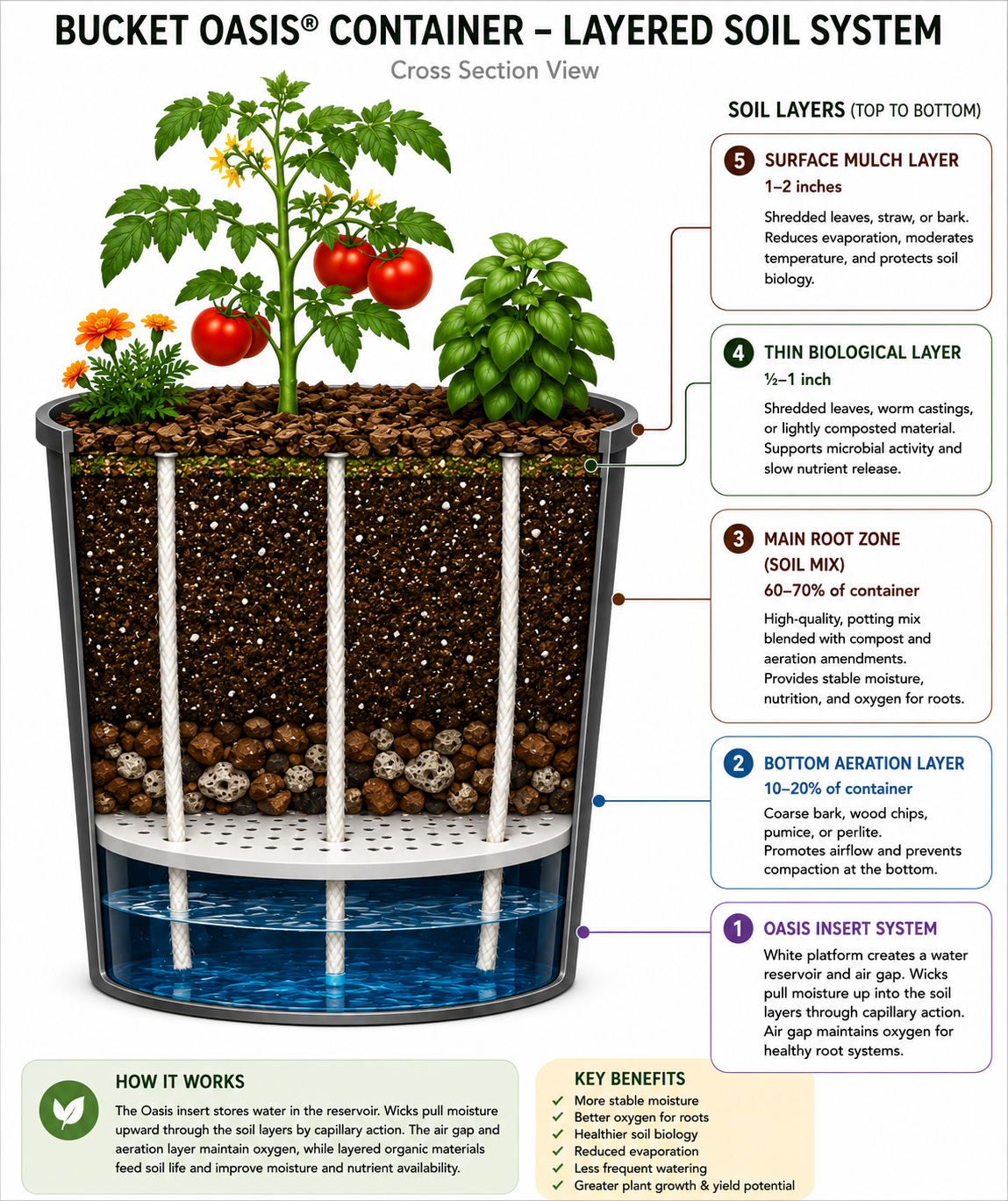
The Bucket Oasis may help layered container systems because:
moisture remains more stable
dry/wet extremes are reduced
oxygen is preserved via the air gap
water enters gradually from below instead of flooding downward
This changes decomposition behavior significantly.
Instead of:
repeatedly soaking the lower soil layers
creating anaerobic pockets
the system supports:
slower moisture movement
more stable microbial activity
improved oxygen retention
That combination is critical for layered biological soils.
The Air Gap May Be One of the Most Important Features
Most people focus only on:
→ the water reservoir.
But the air gap between:
the false floor
andthe reservoir
may be equally important biologically.
Why?
Because decomposing organic matter consumes oxygen aggressively.
The Oasis air gap helps preserve:
root respiration
aerobic microbial activity
healthier decomposition conditions
This may reduce:
sour-smelling soil
anaerobic decomposition
compaction-related failures
especially compared to fully saturated bottom-heavy containers.
The Soil Itself Becomes a Moisture Battery
Organic layers absorb and retain large amounts of moisture.
Combined with wick-fed moisture delivery:
capillary action redistributes water continuously
the soil profile stays more evenly hydrated
drought stress develops more slowly
This means:
the soil itself stores usable moisture
roots remain hydrated longer
refill intervals may extend substantially
especially compared to:
top-watered layered containers that dry unevenly.
What Is “Lasagna Gardening”?
Lasagna gardening is:
→ layering organic materials in alternating “green” and “brown” layers
Examples:
Greens (nitrogen-rich)
kitchen scraps
grass clippings
coffee grounds
fresh compost
Browns (carbon-rich)
leaves
shredded cardboard
straw
wood fibers
Over time:
microbes break the layers down
nutrients are released
soil structure develops naturally
In large raised beds:
this can work extremely well.
Is Lasagna Gardening Good or Bad for Containers?
The realistic answer:
Moderate layering = beneficial
Heavy layering = risky
Small controlled layers can:
improve moisture retention
increase microbial activity
slowly release nutrients
improve soil biology
But excessive fresh organic matter may cause:
root rot
fungus gnats
compaction
heat buildup
anaerobic conditions
The key difference is:
→ whether oxygen remains available.
Best Lasagna Layer Setup for Containers
For most container gardens:
→ thin integrated layers work best.
Not thick compost piles.
Recommended Container Layering Formula
Bottom Aeration Layer (~10–20%)
Purpose:
airflow
drainage protection
oxygen retention
Best materials:
bark chips
coarse wood chips
pumice
perlite
Avoid:
gravel-only bottoms
compacted soil bases
Research shows perched water tables still form above gravel layers.
Main Root Zone (~60–70%)
This is where most roots live.
Ideal mix:
potting soil
compost
aeration material
Recommended ratio:
50–60% potting mix
20–30% compost
10–20% aeration amendment
This creates:
stable moisture
oxygen availability
nutrient availability
Thin Biological Layer (~5–10%)
Optional slow decomposition layer:
shredded leaves
worm castings
lightly composted material
Keep thin:
→ usually under 1 inch thick
Avoid:
thick raw food scrap layers
dense grass clipping mats
Surface Mulch Layer (~1–2 inches)
Purpose:
reduce evaporation
moderate temperature
protect biology
Best options:
shredded leaves
straw
bark mulch
Research shows mulch can reduce container evaporation significantly.
Source:
https://extension.umn.edu/planting-and-growing-guides/watering-container-gardens
Can You Add Kitchen Scraps Directly Into Containers?
Usually only in very small amounts
This is one of the biggest myths online.
Raw food scraps:
decompose slowly in containers
attract fungus gnats
consume oxygen aggressively
Better approach:
→ compost first
OR:
→ use very small buried amounts only occasionally.
What About Worms?
Worms can improve layered container systems
Red wigglers help:
break down organic matter
increase aeration
recycle nutrients
improve microbial activity
But worms require:
oxygen
stable moisture
moderate temperatures
Overly wet layered containers often kill worm populations.
Quantitative Benefits of Organic Layering
Research on compost-amended container soils shows potential improvements in:
moisture retention
nutrient availability
microbial activity
plant growth
Studies have shown compost additions can improve:
→ water-holding capacity by roughly 20–40%
depending on soil composition.
Source:
https://extension.psu.edu/using-compost-in-the-home-garden
Organic matter additions may also:
reduce fertilizer requirements
improve root growth
improve soil aggregation
Can Lasagna Layering Increase Yield?
Sometimes—but only if oxygen remains available
Healthy biological soils can improve:
root development
moisture stability
nutrient cycling
But overloaded organic layers often reduce yields because:
roots lose oxygen
decomposition heats the soil
moisture becomes unstable
In containers:
→ balance matters more than maximum organic matter.
The Best Container Lasagna Strategy
Think “blended ecosystem,” not “stacked compost pile”
The best container systems usually:
mix layers lightly together
prioritize oxygen
use thin organic zones
maintain aeration materials throughout
The goal is:
→ stable biology + stable moisture + stable oxygen.
Not simply adding the most organic matter possible.
The Takeaway
Lasagna gardening can work extremely well in containers:
→ when moisture and oxygen remain balanced.
The biggest risks come from:
excessive fresh organic matter
poor aeration
oxygen depletion
unstable moisture cycles
The Bucket Oasis potentially helps reduce many of these common failures by:
stabilizing moisture
preserving airflow
slowing decomposition extremes
maintaining more consistent root-zone conditions
Research consistently shows that healthy container growth depends on balancing:
moisture
oxygen
biology
nutrient availability
The most successful container systems are not the richest.
They are the most stable.
