
How Much Water Do Plants Actually Need? (And Why Self-Watering Containers Often Stay Moist Longer Than Expected)
One of the most common gardening questions is:
“How much water does this plant need each week?”
But in real-world container gardening, the more important question is often:
“How long can the plant stay healthy before water stress begins?”
Those are not the same thing.
A plant may technically consume:
→ multiple gallons per week
while still remaining healthy for several days after a reservoir appears “empty.”
Why?
Because in well-designed wick-fed systems:
the soil itself stores usable moisture
capillary action redistributes water
roots continue accessing retained moisture throughout the soil profile
This changes not just:
→ total water use
but:
→ how quickly drought stress develops.
Why Container Plants Dry Out So Quickly
Containers naturally:
heat up faster
lose moisture faster
contain limited soil volume
Research shows container plants often require:
→ daily watering during summer heat
especially:
tomatoes
cucumbers
peppers
flowering annuals
Source:
https://www.bhg.com/watering-container-plants-11759072
But traditional top watering also creates another problem:
→ uneven moisture cycling.
The soil may still contain water deep below while:
upper roots dry rapidly
surface soil becomes hydrophobic
plants begin stress responses early
This means gardeners often water:
→ before the soil is truly depleted.
Water Consumption vs Time Until Stress
This distinction is extremely important.
Traditional Top Watering
Typically creates:
saturation peaks
rapid surface drying
uneven moisture zones
localized root stress
Plants often experience stress:
→ long before the entire container is truly dry.
Wick-Fed Subirrigation Systems
Help maintain:
hydraulic continuity
more uniform moisture distribution
active capillary movement through the soil profile
This means:
roots continue accessing moisture longer
the soil acts like a secondary reservoir
drought stress develops more slowly
The result:
→ refill frequency may extend significantly beyond simple gallon-per-week math.
5-Gallon Tomato Container Comparison
Below are realistic estimates comparing:
traditional top watering
vsa wick-fed Oasis-style system
using:
published subirrigation efficiency research
real-world container behavior
moisture retention dynamics
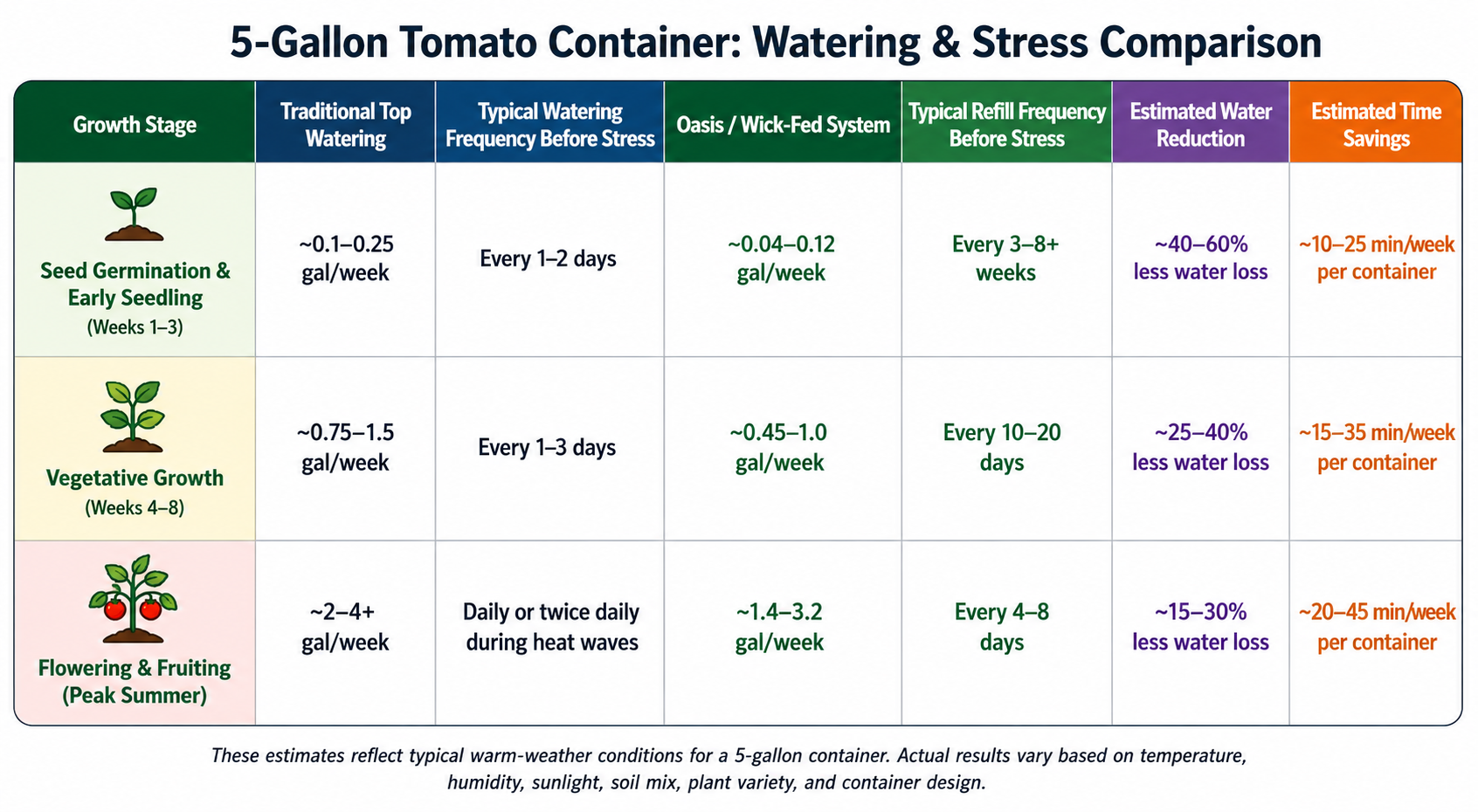
Practical Watering & Stress Comparison Table
Stage 1 — Seed Germination & Early Seedling
Lowest Water Demand — Highest Moisture Sensitivity
Seeds use very little actual water.
But they require:
→ extremely consistent moisture near the surface.
Research shows germination failure commonly occurs when:
→ the upper soil layer dries even briefly.
Source:
https://extension.umn.edu/planting-and-growing-guides/starting-seeds-indoors
This is where wick-fed systems may provide their greatest advantage.
Traditional watering:
repeatedly wets and dries the surface
loses moisture rapidly to evaporation
Wick-fed systems:
maintain stable capillary moisture
reduce repeated rewetting
keep upper soil consistently damp longer
This is why a 1-gallon reservoir can sometimes support seedlings for:
→ several weeks before stress appears.
Stage 2 — Vegetative Growth
Rapidly Increasing Water Demand
As plants establish:
leaf area expands
transpiration increases
root systems become more aggressive
Traditional containers often require:
→ watering every 1–3 days
especially during:
warm weather
wind exposure
direct sun
But the key issue is not just depletion:
→ it’s uneven drying.
Top-watered containers often develop:
dry upper zones
saturated lower zones
inconsistent root hydration
Wick-fed systems help stabilize:
root-zone moisture
capillary redistribution
soil hydration consistency
This delays:
→ the onset of visible drought stress.
Stage 3 — Flowering & Fruiting
Maximum Plant Water Demand
At this stage:
foliage mass is large
transpiration is intense
fruit development consumes enormous resources
A mature tomato may genuinely transpire:
→ several gallons per week during peak heat.
This means:
true biological water demand now dominates total water use.
However:
traditional watering still creates:
runoff loss
uneven moisture
repeated stress cycles
Wick-fed systems cannot eliminate the plant’s true water demand.
But they CAN:
reduce wasted water
stabilize the root zone
extend the time before drought stress occurs
This is why:
even when reservoirs empty faster during fruiting,
plants may still remain healthy for:
→ several additional days before refill becomes urgent.
Why Reservoir Systems Last Longer Than Expected
Many gardeners assume:
→ “1 gallon reservoir = 1 gallon of usable water.”
But in wick-fed systems:
the soil itself becomes:
→ a secondary moisture reservoir.
Water remains stored:
between soil particles
around wick zones
throughout capillary pathways
This retained moisture continues supplying roots even after:
→ free-standing reservoir water declines.
The Most Important Insight
The biggest benefit of wick-fed systems may not simply be:
→ using less water.
It may be:
→ slowing the onset of plant stress.
That changes everything about container gardening.
Instead of:
rapid dry/wet swings
emergency watering cycles
daily stress management
the plant experiences:
more stable hydration
longer moisture buffering
more consistent root conditions
Estimated Water Savings by Growth Stage
Compared to traditional top watering:
Seedling Stage
→ ~40–60% less water loss
Vegetative Stage
→ ~25–40% less water loss
Fruiting Stage
→ ~15–30% less water loss
Research on subirrigation systems consistently shows:
reduced evaporation
reduced runoff
improved water-use efficiency
Source:
https://www.mdpi.com/2073-4441/12/5/1313
Estimated Time Savings
Single Container
Potential savings:
→ ~10–45 minutes/week
Multiple Containers
Number of Containers vs Estimated Time Savings
1 container ~20–45 min/week
5 containers ~1–3 hours/month
10 containers Several hours/week during peak summer
The larger the garden:
→ the larger the practical benefit becomes.
How the Bucket Oasis Changes Water Behavior
Traditional watering:
floods soil
increases evaporation
encourages runoff
creates moisture instability
The Bucket Oasis:
gradually replenishes water from below
stabilizes moisture distribution
maintains capillary hydration pathways
reduces rapid dry-out cycles
This allows:
longer stress-free intervals
more consistent root hydration
less reactive watering behavior
The Takeaway
Plants do not simply “consume water.”
A large percentage of watering problems come from:
uneven moisture distribution
evaporation loss
runoff
rapid dry/wet cycling
Wick-fed subirrigation systems improve:
moisture stability
water-use efficiency
root-zone consistency
The result is not just:
→ less watering
but:
→ longer periods before plants experience drought stress.
And for container gardeners, that distinction can dramatically change both:
plant health
andmaintenance demands.
