
Viral Homemade Fertilizers for Container Gardens: Which Internet Gardening Hacks Actually Work?
Every gardening season brings a new wave of viral advice. One video claims soaking banana peels creates a potassium-rich fertilizer. Another recommends saving pasta water after dinner to feed tomatoes. Others insist Epsom salt is the secret to enormous peppers or that wood ash transforms acidic soils overnight.
Some of these practices have been used for generations, while others gained popularity through TikTok, YouTube, Facebook gardening groups, and Reddit. Unfortunately, popularity doesn't always equal effectiveness.
The challenge is that many viral gardening hacks have never been formally studied. Others contain a kernel of scientific truth but are often exaggerated online. Some genuinely work—but only under specific soil conditions.
This article separates fact from fiction by comparing three different types of evidence.
• Consumer experiences shared by home gardeners
• Recommendations from universities and agricultural professionals
• Published scientific research
When research is unavailable, we label the evidence as Inconclusive rather than assuming the method is ineffective.
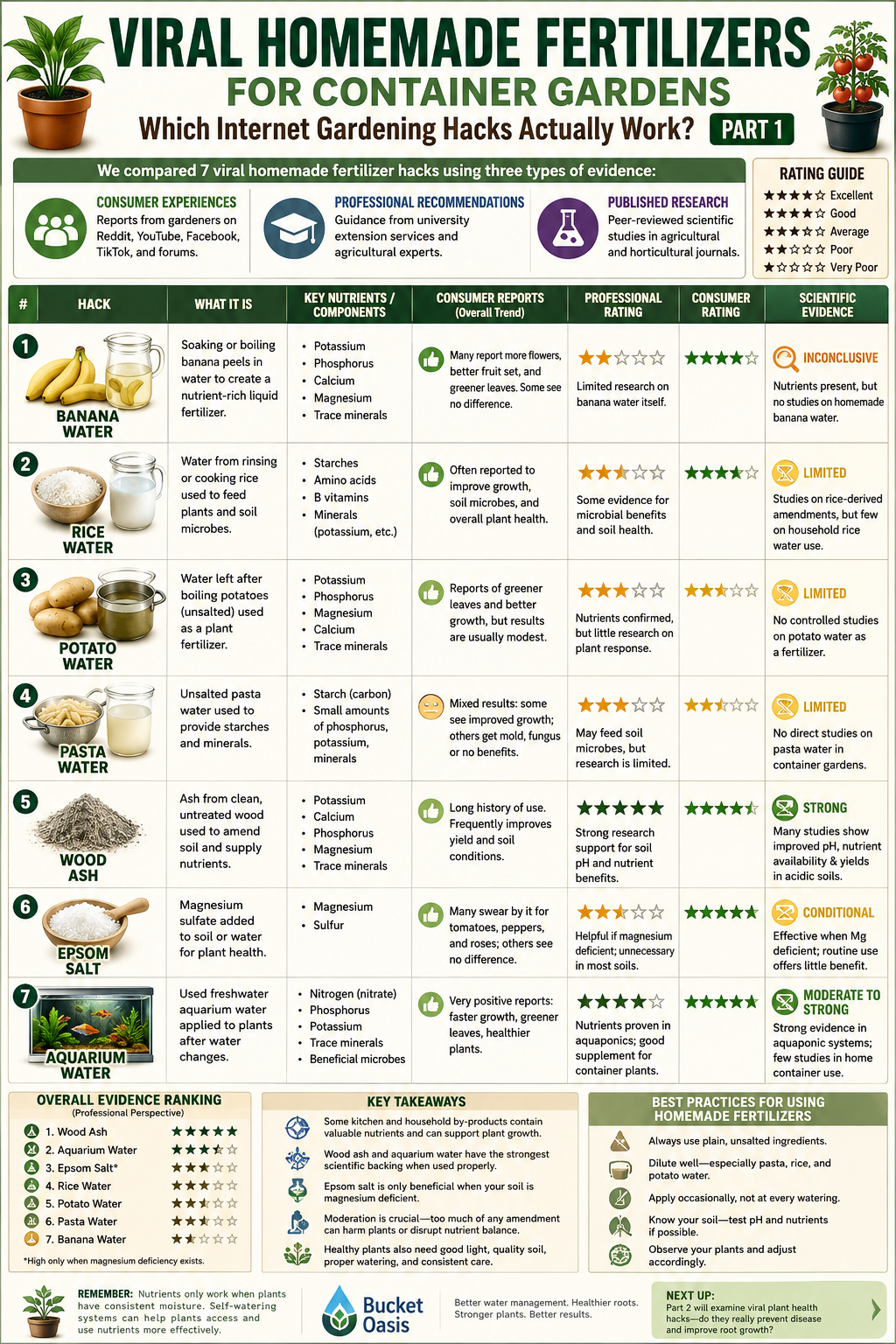
How We Rated Each Gardening Hack
⭐ Professional Rating
Based on:
Peer-reviewed scientific studies
University Extension publications
USDA recommendations
Commercial horticultural practices
⭐ Consumer Rating
Based on:
Consistency of gardener reports
Popularity within gardening communities
Ease of use
Reported succes
1. Banana Water
🌐 Viral Claim
Soaking or boiling banana peels creates a potassium-rich fertilizer that improves flowering, fruit production, and overall plant health.
👩🌾 Consumer Experiences
Banana water is one of the most frequently recommended homemade fertilizers online.
Thousands of gardeners report:
Larger tomato harvests
More flowers
Greener foliage
Healthier peppers
Better transplant recovery
However, many gardeners also report seeing little or no measurable improvement after months of use.
One common misconception is that banana peels release large amounts of potassium into water simply by soaking overnight. While potassium is water soluble, the amount extracted depends heavily on preparation method, water volume, temperature, and soaking time.
🔬 Published Research
What Research Supports
Banana peels contain valuable nutrients including:
Potassium
Calcium
Magnesium
Phosphorus
Laboratory studies confirm these nutrients are present in banana peel tissue.
Researchers have also studied methods for extracting nutrients from banana peels for agricultural and industrial applications.
What Research Doesn't Show
Very few peer-reviewed studies have tested homemade banana water itself as a fertilizer.
Most available research examines:
composted banana peels
dried banana peel powders
chemically extracted nutrients
These are not equivalent to soaking peels in a bucket of water for several days.
Several university extension specialists note that there is currently little scientific evidence showing homemade banana water consistently improves plant growth.
Evidence Status
Inconclusive
📈 Reported Performance Improvements
MeasurementConsumer ReportsPublished StudiesFlower productionFrequently improvedNo direct studiesFruit yieldOften improvedNo direct studiesLeaf colorFrequently reportedNot measuredRoot growthOccasionally reportedNot measuredPotassium availabilityAssumedNutrients confirmed in peel, extraction varies
⭐ Ratings
Professional Rating
⭐⭐☆☆☆
Consumer Rating
⭐⭐⭐⭐☆
Bottom Line
Banana peels unquestionably contain nutrients, but there is currently little published evidence demonstrating that homemade banana water provides enough plant-available nutrients to consistently improve container plant growth. Composting banana peels remains the better-supported method.
References
University of Minnesota Extension – Composting fruit and vegetable waste
University of Illinois Extension – Common fertilizer myths
Peer-reviewed studies on banana peel nutrient composition (Journal of Environmental Management; Waste and Biomass Valorization)
2. Rice Water
🌐 Viral Claim
Water left over from rinsing or cooking rice contains vitamins, minerals, and starches that feed plants and beneficial soil microbes.
👩🌾 Consumer Experiences
Rice water has become especially popular among indoor plant enthusiasts.
Reported benefits include:
Faster seedling growth
Greener leaves
Improved flowering
Better root development
Many gardeners also appreciate that it recycles kitchen waste rather than pouring it down the drain.
Others report no noticeable difference compared to ordinary watering.
🔬 Published Research
What Research Supports
Rice water contains dissolved:
starches
amino acids
trace minerals
Several agricultural studies have investigated fermented rice water and rice-derived microbial solutions as soil amendments.
Some experiments found improvements in microbial activity and soil biological health.
What Research Doesn't Show
Few studies have evaluated ordinary household rice rinse water used exactly as promoted on social media.
Results depend heavily on:
rice variety
number of rinses
fermentation
dilution
application frequency
Most studies examine controlled agricultural formulations rather than leftover kitchen water.
Evidence Status
Limited Evidence
📈 Reported Performance Improvements
MeasurementConsumer ReportsPublished StudiesSeedling vigorFrequently reportedSome evidenceSoil microbesFrequently reportedSupported in several studiesYieldOccasionally reportedLimitedRoot growthMixedLimited
⭐ Ratings
Professional Rating
⭐⭐⭐☆☆
Consumer Rating
⭐⭐⭐⭐☆
Bottom Line
Rice water has more scientific support than many viral fertilizer hacks, particularly regarding soil microbial activity. However, evidence for substantial improvements in plant growth from ordinary household rice rinse water remains limited.
References
MDPI Agronomy – Rice-derived amendments and soil microorganisms
Frontiers in Microbiology – Beneficial microorganisms in sustainable agriculture
USDA Natural Resources Conservation Service – Soil biology resources
3. Potato Water
🌐 Viral Claim
Water left over from boiling potatoes contains potassium, phosphorus, magnesium, and other minerals that help vegetables, flowers, and houseplants grow larger and healthier.
Many gardeners recommend allowing the water to cool before using it to irrigate plants rather than pouring it down the drain.
👩🌾 Consumer Experiences
Potato water has steadily gained popularity in gardening groups because it is simple, free, and reduces kitchen waste.
Gardeners commonly report:
Faster vegetative growth
Greener leaves
Increased flowering
Better tomato production
Improved recovery after transplanting
Most users recommend using only plain potato water. Salted water is almost universally discouraged because excess sodium damages soil structure and can interfere with water uptake by roots.
Unlike banana water, there are relatively few reports claiming dramatic improvements. Most gardeners describe modest benefits rather than miracle results.
🔬 Published Research
What Research Supports
Potatoes naturally contain several nutrients essential for plant growth, including:
Potassium
Phosphorus
Magnesium
Calcium
Small amounts of nitrogen compounds
During boiling, a portion of these water-soluble nutrients diffuses into the cooking water.
Food chemistry studies have consistently shown that boiling vegetables transfers minerals into the surrounding water.
Research also confirms that potassium is among the most mobile nutrients during cooking.
What Research Doesn't Show
Very few studies have evaluated boiled potato water as a fertilizer under real gardening conditions.
Researchers have measured nutrient losses from potatoes during cooking, but almost none have followed the next step of applying that water to container plants.
Therefore, while nutrient transfer is well documented, actual improvements in plant growth remain largely untested.
Evidence Status
Limited Evidence
📈 Reported Performance Improvements
MeasurementConsumer ReportsPublished StudiesGreener foliageFrequently reportedNot directly studiedFlower productionOccasionally reportedNot studiedVegetable yieldMixed reportsNo controlled trialsNutrient contentConfirmedConfirmed
⭐ Ratings
Professional Rating
⭐⭐⭐☆☆
Consumer Rating
⭐⭐⭐☆☆
Bottom Line
Potato water clearly contains plant nutrients, but little research has measured whether those nutrients significantly improve plant growth. It is a reasonable way to recycle nutrients—as long as no salt, butter, milk, or oil has been added.
References
USDA FoodData Central – Potato nutrient composition
Journal of Food Composition and Analysis – Mineral losses during cooking
Food Chemistry – Nutrient retention during boiling
4. Pasta Water
🌐 Viral Claim
Unsalted pasta water contains starches and minerals that feed beneficial soil microbes while providing nutrients to plants.
Some gardeners also claim the starch acts as a slow-release carbon source for healthy soil biology.
👩🌾 Consumer Experiences
Among kitchen-waste fertilizers, pasta water receives mixed reviews.
Positive reports include:
Improved leafy growth
Increased microbial activity
Better moisture retention
Reduced fertilizer use
Negative experiences usually involve:
Mold growth
Fungus gnats
Unpleasant odors
Sticky soil surfaces
Many experienced gardeners recommend diluting pasta water before application and using it only occasionally.
Salted pasta water is widely considered harmful because sodium accumulates in containers and can damage roots.
🔬 Published Research
What Research Supports
Plain pasta water contains:
Starch
Small amounts of phosphorus
Potassium
Trace minerals
Microorganisms readily consume starch as an energy source.
Soil biology research consistently demonstrates that organic carbon sources stimulate microbial populations.
What Research Doesn't Show
Researchers have not specifically studied household pasta water as a fertilizer.
No published studies compare:
pasta water versus plain water
diluted versus full-strength applications
long-term effects on container soils
Excess starch may encourage microbial growth, but excessive microbial activity can temporarily tie up nitrogen while microbes decompose available carbon.
Evidence Status
Limited Evidence
📈 Reported Performance Improvements
MeasurementConsumer ReportsPublished StudiesSoil microbesFrequently reportedCarbon effects supportedPlant growthMixedNot directly studiedYieldLimited reportsNoneRoot growthNot studiedNone
⭐ Ratings
Professional Rating
⭐⭐⭐☆☆
Consumer Rating
⭐⭐⭐☆☆
Bottom Line
Unsalted pasta water is unlikely to harm healthy container plants when used sparingly, but strong scientific evidence demonstrating improved growth is currently lacking.
References
USDA National Agricultural Library – Soil microorganisms
Frontiers in Microbiology – Carbon cycling in soils
Soil Biology & Biochemistry – Carbon inputs and microbial communities
5. Wood Ash
🌐 Viral Claim
Wood ash is a natural fertilizer rich in potassium and calcium that dramatically improves vegetable gardens, sweetens acidic soil, and increases harvests.
This practice has been used for centuries, particularly in vegetable gardens and orchards.
👩🌾 Consumer Experiences
Unlike many viral gardening hacks, wood ash has a long agricultural history.
Gardeners frequently report:
Better tomato production
Improved cabbage growth
Stronger onions
Increased flowering
Healthier fruit trees
Negative experiences generally involve applying excessive amounts, leading to:
Yellowing leaves
Poor growth
Nutrient deficiencies
Excessively alkaline soils
Experienced gardeners often stress that wood ash should be used only after understanding the soil's pH.
🔬 Published Research
What Research Supports
Wood ash is one of the best-researched homemade soil amendments.
It commonly contains:
Calcium carbonate
Potassium
Phosphorus
Magnesium
Numerous micronutrients
Research has shown that wood ash can:
Increase soil pH
Reduce soil acidity
Supply plant-available potassium
Improve calcium availability
Increase yields in acidic soils
Multiple agricultural studies have reported measurable improvements in crop production when wood ash was applied at appropriate rates.
What Research Doesn't Show
Wood ash is not universally beneficial.
It is generally not recommended for:
Blueberries
Azaleas
Rhododendrons
Potatoes prone to common scab
Acid-loving ornamentals
Excessive applications may also reduce availability of iron, manganese, and other micronutrients.
Evidence Status
Strong Evidence
📈 Reported Performance Improvements
MeasurementConsumer ReportsPublished StudiesSoil pHConsistent improvementStrong evidencePotassium availabilityConsistentStrong evidenceCrop yieldFrequently improvedMultiple studies support increases in acidic soilsCalcium availabilityFrequently improvedStrong evidence
⭐ Ratings
Professional Rating
⭐⭐⭐⭐⭐
Consumer Rating
⭐⭐⭐⭐☆
🪴 Bucket Oasis Perspective
Wood ash supplies valuable nutrients, but those nutrients are only effective when plants have sufficient water to transport them into the root system. Consistent moisture also reduces nutrient stress during hot weather, allowing plants to better utilize soil amendments.
Bottom Line
Wood ash is one of the few homemade fertilizers strongly supported by scientific research. However, it should be viewed as a soil amendment rather than a universal fertilizer. Always avoid ash from painted, treated, or chemically contaminated wood, and apply only after considering your soil's pH.
References
University of Vermont Extension – Using Wood Ash in the Home Garden
University of Maine Cooperative Extension – Using Wood Ash Wisely
Iowa State University Extension – Wood Ash as a Soil Amendment
Demeyer, A., Voundi Nkana, J.C., & Verloo, M.G. (2001). Characteristics of wood ash and influence on soil properties and nutrient uptake: An overview. Bioresource Technology.
Pitman, R.M. (2006). Wood Ash Use in Forestry – A Review. Forestry.
6. Epsom Salt
🌐 Viral Claim
Adding Epsom salt (magnesium sulfate) around tomatoes, peppers, roses, and houseplants produces greener leaves, stronger stems, larger vegetables, sweeter fruit, and dramatically higher yields.
This is one of the oldest and most widespread gardening recommendations on the internet.
👩🌾 Consumer Experiences
Few homemade fertilizers have as many passionate supporters as Epsom salt.
Gardeners commonly report:
Dark green foliage
Increased flowering
Reduced blossom-end rot
Larger tomatoes
Better peppers
Faster seed germination
Healthier roses
Many users claim it is the "secret ingredient" for successful tomato production.
However, many experienced gardeners report no measurable improvements at all.
Commercial growers and university specialists frequently note that positive results often occur only when plants are actually deficient in magnesium.
🔬 Published Research
What Research Supports
Epsom salt is chemically magnesium sulfate (MgSO₄·7H₂O).
Magnesium is essential because it:
Forms the center of every chlorophyll molecule.
Activates hundreds of plant enzymes.
Supports photosynthesis.
Assists phosphorus movement.
Contributes to sugar production.
Sulfur is also an essential nutrient involved in amino acid and protein production.
Research clearly demonstrates that correcting a magnesium deficiency improves plant growth.
Numerous studies have shown that magnesium fertilization can increase yield when soils are deficient.
What Research Doesn't Show
The key question isn't whether magnesium is important—it absolutely is.
The question is whether most gardens actually need additional magnesium.
According to numerous university extension services, most North American garden soils already contain sufficient magnesium.
Multiple universities—including Washington State University, University of Illinois, University of Minnesota, and Oregon State University—state there is little evidence that routine Epsom salt applications improve tomatoes or peppers unless a soil test confirms magnesium deficiency.
Several studies have also shown excessive magnesium can interfere with calcium and potassium uptake, potentially creating nutrient imbalances.
Evidence Status
Strong evidence for correcting magnesium deficiencies.
Weak evidence for routine use in healthy soils.
📈 Reported Performance Improvements
MeasurementConsumer ReportsPublished StudiesGreener foliageFrequently reportedYes, if Mg deficientChlorophyll productionReportedStrong supportFruit yieldFrequently reportedOnly when deficientBlossom-end rotFrequently reportedLittle evidence (primarily caused by calcium transport issues)Flower productionMixedLimited
⭐ Ratings
Professional Rating
⭐⭐⭐☆☆
Consumer Rating
⭐⭐⭐⭐⭐
❓ Research Gap
Most published studies examine magnesium fertilization under agricultural production systems where soil nutrient levels are known.
Few studies evaluate the "one tablespoon per plant" recommendations commonly shared on social media.
Future research comparing common internet application rates against soil-tested control groups would help determine whether these practices provide measurable benefits for home gardeners.
🪴 Bucket Oasis Perspective
Magnesium can only move into plants with water. During drought conditions, even nutrient-rich soils may not supply adequate magnesium because water movement through the soil slows dramatically. Maintaining consistent moisture helps roots absorb nutrients already present in the growing medium, whether they come from fertilizer, compost, or naturally occurring minerals.
Bottom Line
Epsom salt is not a miracle fertilizer—but it isn't a myth either.
If your soil or potting mix lacks magnesium, Epsom salt can significantly improve plant health. If magnesium levels are already adequate, additional applications are unlikely to increase growth or yield and may contribute to nutrient imbalances.
References
Washington State University Extension – Myths About Epsom Salt in the Garden
University of Illinois Extension – Should You Use Epsom Salts in the Garden?
University of Minnesota Extension – Understanding Plant Nutrients
Oregon State University Extension – Magnesium Deficiency in Plants
Marschner, H. (2012). Mineral Nutrition of Higher Plants.
7. Aquarium Water
🌐 Viral Claim
Used aquarium water is a complete natural fertilizer rich in nitrogen, phosphorus, potassium, and beneficial microorganisms that can replace commercial fertilizers for many container plants.
Unlike many viral hacks, this recommendation originates from both hobby gardeners and professional aquaponics enthusiasts.
👩🌾 Consumer Experiences
Aquarium owners have reused tank water for decades rather than pouring it down the drain during routine water changes.
Gardeners commonly report:
Faster leafy growth
Greener foliage
Improved houseplant health
Better vegetable production
Reduced need for commercial fertilizer
Most successful reports involve freshwater aquariums containing healthy fish populations.
Saltwater aquarium water is generally not recommended because excessive salinity damages most terrestrial plants.
🔬 Published Research
What Research Supports
Aquarium water naturally accumulates dissolved nutrients produced through the nitrogen cycle.
Fish waste is converted by beneficial bacteria into:
Ammonium
Nitrite
Nitrate
Nitrate serves as a readily available nitrogen source for plants.
Aquaponic systems—which intentionally combine fish production with plant cultivation—have been extensively studied.
Research consistently demonstrates that fish waste can successfully support vegetable production when nutrient concentrations are properly managed.
Aquarium water also contains dissolved phosphorus, potassium, calcium, magnesium, and trace elements, although concentrations vary widely depending on fish species, feeding rates, filtration systems, and maintenance schedules.
What Research Doesn't Show
Most scientific research focuses on aquaponic systems with continuous nutrient cycling rather than occasional applications of household aquarium water.
Little published research compares ordinary aquarium water to commercial fertilizers in container gardens.
Additionally, nutrient concentrations vary so much between aquariums that no single application rate can be universally recommended.
Evidence Status
Moderate to Strong Evidence
📈 Reported Performance Improvements
MeasurementConsumer ReportsPublished StudiesLeaf growthFrequently improvedSupported by aquaponics researchNitrogen availabilityConsistentStrong supportVegetable yieldFrequently improvedSupported in aquaponic systemsRoot growthFrequently reportedModerate supportSoil microbesReportedSome evidence
⭐ Ratings
Professional Rating
⭐⭐⭐⭐☆
Consumer Rating
⭐⭐⭐⭐⭐
❓ Research Gap
While aquaponics has been extensively researched, relatively few studies evaluate the use of aquarium water as an occasional fertilizer in traditional container gardens.
Controlled experiments comparing aquarium water with standard soluble fertilizers under identical growing conditions would help determine its practical value for home gardeners.
Bottom Line
Aquarium water is one of the most scientifically plausible homemade fertilizers discussed in this series. Unlike many internet hacks, it contains measurable plant nutrients generated through natural biological processes. While it should not completely replace balanced fertilization, reusing freshwater aquarium water is an effective way to recycle nutrients that would otherwise be discarded.
Overall Professional Rankings
HackProfessional RatingConsumer RatingScientific EvidenceWood Ash⭐⭐⭐⭐⭐⭐⭐⭐⭐☆StrongAquarium Water⭐⭐⭐⭐☆⭐⭐⭐⭐⭐Moderate to StrongRice Water⭐⭐⭐☆☆⭐⭐⭐⭐☆LimitedPotato Water⭐⭐⭐☆☆⭐⭐⭐☆☆LimitedPasta Water⭐⭐⭐☆☆⭐⭐⭐☆☆LimitedEpsom Salt⭐⭐⭐☆☆⭐⭐⭐⭐⭐Strong only for magnesium-deficient soilsBanana Water⭐⭐☆☆☆⭐⭐⭐⭐☆Inconclusive
Key Takeaways
Not all viral gardening hacks deserve to be dismissed—but not all deserve unquestioning praise either. Some, like wood ash and aquarium water, have strong scientific foundations when used appropriately. Others, such as banana water and potato water, are based on sound principles but lack sufficient research to confirm consistent benefits under typical home gardening conditions.
The most important lesson is that plant growth depends on more than nutrients alone. Light, soil structure, root health, temperature, and consistent moisture all influence whether plants can effectively absorb and use available nutrients. Even the best fertilizer cannot compensate for chronic drought stress or poorly managed growing conditions.
In the next article, we'll explore viral plant health hacks—including cinnamon, aloe vera, hydrogen peroxide, willow water, milk sprays, baking soda, and other popular remedies—to see which are supported by science and which remain largely anecdotal.
