How plants pull water through wicks (and why it works)
At first glance, a cotton wick in a planter seems almost too simple to matter.
It’s just a string.
But in reality, that wick is doing something powerful—it’s acting as a bridge that allows water to move upward, against gravity, and into the root zone.
To understand why this works, we need to look at how water actually moves.
Not by force—but by attraction.
The “drinking straw” analogy (with a twist)
It’s tempting to think of a wick like a drinking straw for plants.
That’s close—but not quite accurate.
A straw works because you suck water upward using pressure.
A wick works differently.
Water climbs the wick on its own through something called capillary action—the same phenomenon that lets water move through paper towels or rise inside tiny tubes.
Instead of being pushed or pulled, water is attracted to the fibers of the cotton and to itself. These tiny forces combine and literally pull water upward through the material.
So a better way to think about it is:
The wick is a passive pathway…
The plant is the demand signal…
The physics does the work.
And importantly—this happens continuously.
Why cotton wicks work so well
Not all materials wick equally.
Cotton performs well because:
It’s highly absorbent
It has a dense network of fine fibers
It creates many small capillary channels
Studies on wick irrigation systems show that water is drawn from a reservoir into the root zone through the wick, supplying moisture gradually based on plant demand.
Some tests have shown capillary rise in wick materials reaching 25–50 cm (10–20 inches), depending on material and structure.
That’s more than enough to move water from a bottom reservoir into a full container of soil.
What happens once water leaves the wick
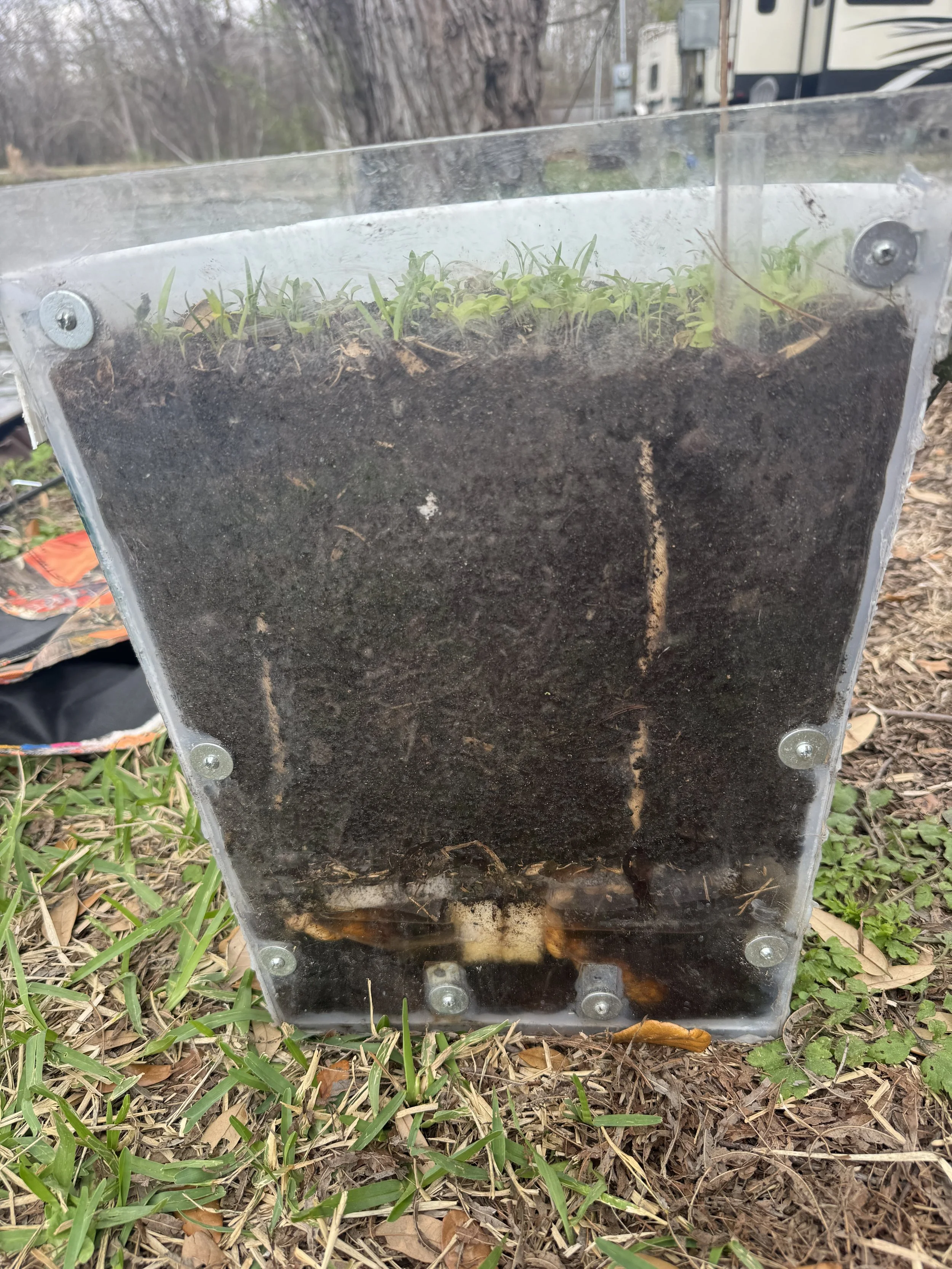
The wick doesn’t just deliver water—it creates a localized moisture zone in the soil.
From there, water spreads outward through the soil via capillary movement. Water doesn’t instantly saturate the entire container, it creates a gradient.
Closest to the wick:
Soil is near saturation (very wet)
Moving outward:
Moisture decreases gradually
At the edges:
Soil may remain only lightly moist or even dry
In most soils, this “wetting radius” depends on:
soil type (coarse vs fine)
compaction
organic content
In practical terms for container soil:
The highest saturation zone is typically within ~0.5–1.5 inches of the wick
Beyond that, moisture transitions gradually rather than abruptly
This gradient is actually beneficial—it prevents the entire container from becoming waterlogged while still giving roots access to water.
Roots will naturally grow toward this moisture zone.
Why multiple wicks matter
Because each wick creates its own moisture zone, the number and placement of wicks directly affects coverage.
Think of each wick as a “hydration node.”
More wicks:
More even moisture distribution
Larger total wetted area
Faster recharge of soil moisture
Fewer wicks:
More localized watering
Greater dry zones between wicks
Slower overall moisture delivery
This is where sizing becomes important.
How many wicks should you use?
The Bucket Oasis includes:
3 cotton wicks (3/16" diameter)
Designed to work well in a ~5 gallon container
That’s a solid baseline—but scaling matters.
Here’s a practical framework:
Small containers (~1 gallon)
1 wick is typically sufficient
2 if using very thirsty plants or fast-draining soil
3 wicks can lead to overly saturated conditions, especially in dense soil
Medium containers (3–5 gallon)
2–3 wicks works well
Matches your current Oasis configuration
Large containers (7+ gallon)
3+ wicks recommended
Spacing becomes more important than count alone
Why 3 wicks in a 1 gallon container can be too much
In a smaller volume:
The moisture zones from each wick overlap heavily
The soil has less ability to buffer excess water
Oxygen levels can drop if saturation stays too high
Wick irrigation systems are known to provide continuous water availability, which is beneficial—but can oversupply low-water plants if not sized correctly ().
So yes—3 wicks in a 1 gallon container can absolutely be excessive, depending on:
plant type
soil mix
environmental conditions
The goal isn’t maximum water delivery—it’s balanced delivery.
A system that responds, not floods
One of the most important (and often overlooked) aspects of wick systems:
Plants effectively regulate their own intake.
As roots pull water from the soil:
moisture near the wick decreases
capillary action pulls more water upward
equilibrium is maintained
This creates a responsive loop:
plant demand → wick delivery → soil balance
Rather than a fixed watering event, it’s a continuous adjustment.
Bringing it back to the Oasis
The reason the Bucket Oasis uses multiple cotton wicks isn’t just to move water—it’s to control how water is distributed.
The reservoir stores supply
The wicks define delivery points
The soil spreads and buffers moisture
The plant dictates usage
Getting the number of wicks right is what turns the system from “wet” into “stable.”
And that’s the difference between keeping plants alive—and helping them thrive.
In the next post, we’ll break down how to choose the right wick configuration based on plant type, soil mix, and environment—so you can dial the system in with precision.